
This playbook is for digital agencies, Shopify partners and payment consultants who implement payment orchestration for a merchant that already runs Shopify. It is written as a delivery guide, not as a case study. There are no invented ROAS figures, authorization lifts or "client saved X%" claims.
Temble-specific facts below come from public pages retrieved 2026-11-09. Re-check the integrations directory and pricing page before you put dates in a statement of work.
Key Takeaways
- Treat migration as connect → prove → cut over → hypercare, not as a theme redesign.
- On Shopify, respect the card-provider model; a routing layer typically fills the third-party card slot. See the Shopify routing guide.
- Temble connects Shopify from the dashboard; hosted checkout takes the payment step and hands the order back; the theme stays the merchant's (integrations directory, retrieved 2026-11-09).
- Funds settle in connected Stripe or Finix accounts; Temble does not hold merchant funds and does not retry declines on another account (Temble homepage, retrieved 2026-11-09).
- Agencies can apply to the Solutions track on the partner program for enablement and commercial terms. This article does not replace the Partner Agreement.
In this guide
- When to recommend orchestration (and when not to)
- Roles on the engagement
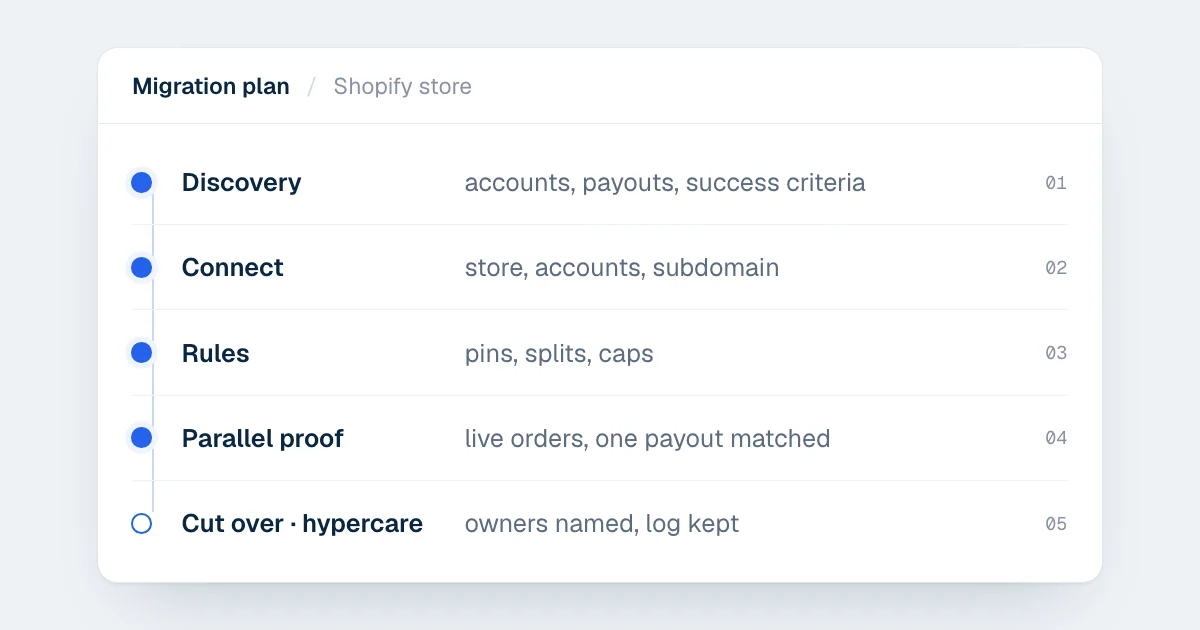
- Phase 0: Discovery (3 to 5 business days)
- Phase 1: Sandbox and connections
- Phase 2: Rules workshop (not a surprise at cutover)
- Phase 3: Parallel proof
- Phase 4: Cutover
- Phase 5: Hypercare (1 to 2 weeks)
- Commercial and partner framing
- Common failure modes (and fixes)
- Frequently asked questions
- Conclusion
When to recommend orchestration (and when not to)
Recommend exploration when the merchant already holds two payment accounts or must split volume or risk. Also recommend it when the merchant needs one ledger across Shopify and another channel, or cannot reach a second account from checkout today. Use the decision list in Should You Run Multiple Payment Providers?.
Do not lead with orchestration when a single provider covers the merchant's markets and methods, or when the real request is a lower rate. The same applies when nobody on the merchant side will own rules after you leave. A prettier checkout on one PSP is a different project.
Roles on the engagement
| Role | Owns |
|---|---|
| Agency lead | Scope, timeline, merchant communications |
| Technical implementer | Shopify connection, domain/DNS for checkout subdomain, test orders |
| Merchant finance | Payout matching, fee expectations, tax/revenue questions |
| Merchant ops/support | Refund macros, dispute ownership (chargebacks vs refunds) |
| Merchant marketing | Funnel pins, promo codes, launch dates |
Write names next to roles before kickoff. Unnamed ownership is the most common silent failure mode.
Phase 0: Discovery (3 to 5 business days)
Collect, in a shared folder:
- Legal entities and which Stripe/Finix (or candidate) accounts map to which.
- Current Shopify payment settings screenshots (Shopify Payments, third-party provider, wallets, BNPL).
- Last 30 days of payout reports from each provider.
- Refund policy and dispute volume qualitative notes (counts if the merchant shares them; do not invent).
- Theme constraints, checkout customizations, subscriptions apps, and any headless storefront pieces.
- Success criteria in merchant language, for example "one export with provider column," "70/30 split live," or "EU funnel pinned to account B." Not "higher auth rate."
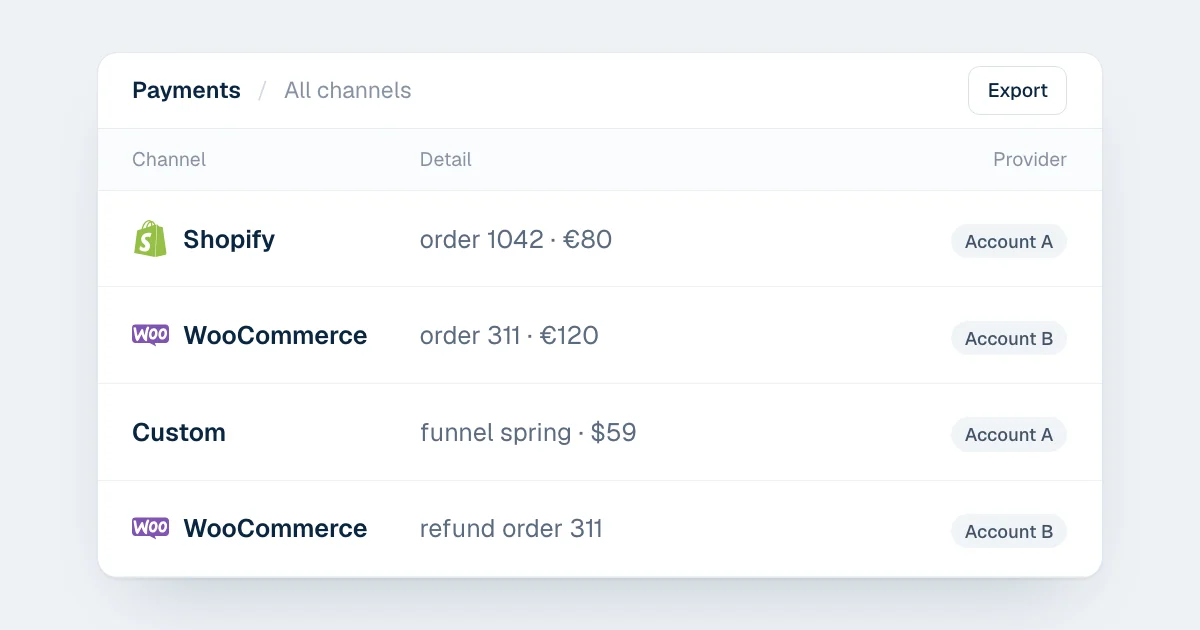
Deliverable: a one-page architecture diagram (store → orchestration checkout → connected accounts) and a written decline-behavior note. For Temble, that note must say declines are not retried on another account (Temble homepage, retrieved 2026-11-09).
Phase 1: Sandbox and connections
- Create or access the Temble account and connect Shopify from the dashboard (integrations directory).
- Connect payment accounts the merchant already owns. The integrations directory lists Stripe and Finix as Live processor destinations (integrations directory, retrieved 2026-11-09). Do not promise Adyen, Airwallex or others unless the live directory says so at SOW time. Marketing illustrations on a homepage are not the integrations catalog.
- Checkout subdomain. Temble hosts checkout on the merchant's subdomain (Temble homepage, retrieved 2026-11-09). Complete DNS with the merchant's IT owner. Confirm TLS.
- Wallets. If Apple Pay or Google Pay are in scope, follow Wallets at Checkout. Temble registers the Apple Pay domain for you, per the integrations copy.
- BNPL. Only if enabled on the connected account: Klarna, Afterpay and Affirm are Via your account (integrations directory; BNPL guide).
- Test matrix (write pass/fail): authorize, decline, partial refund, full refund, wallet pay, promo code if used. Save IDs in the project doc.
Temble plugin/app behavior for Shopify: hosted checkout takes the payment step and hands the order back; theme remains the merchant's (integrations directory).
Phase 2: Rules workshop (not a surprise at cutover)
Draft rules in merchant-readable language first:
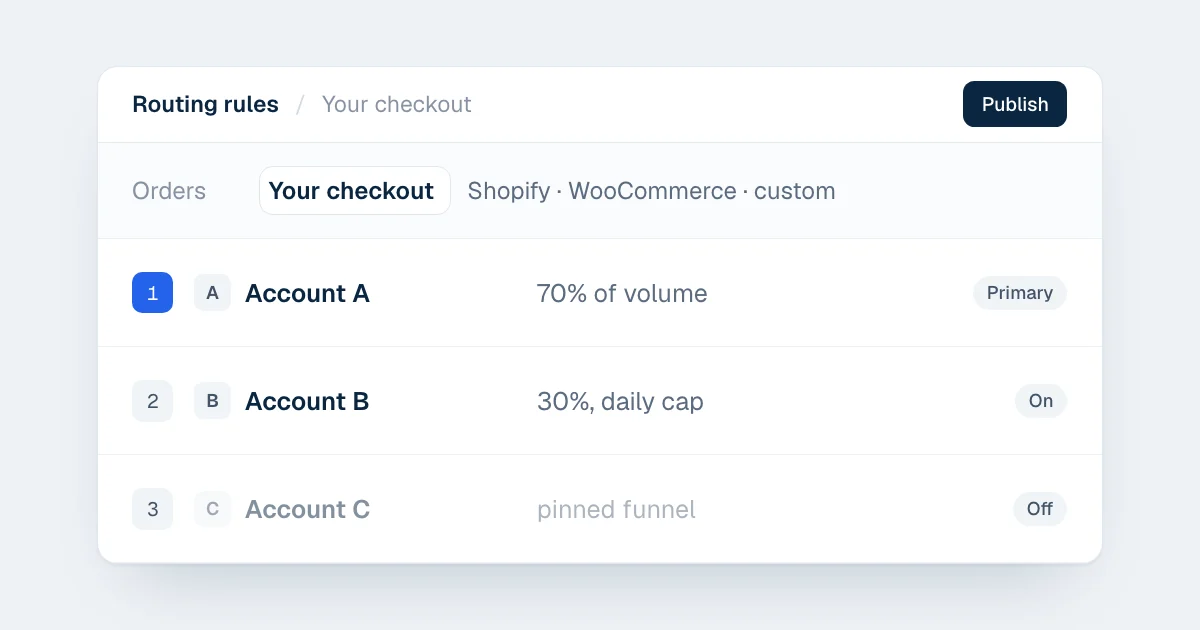
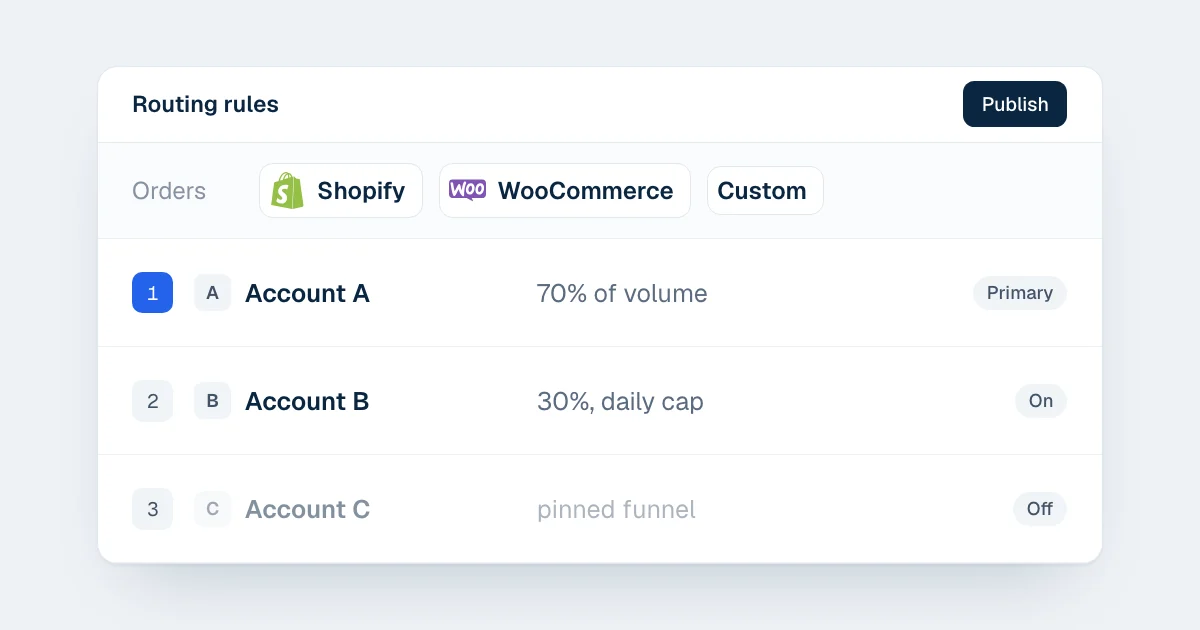
- Percentage splits across accounts.
- Daily caps and spill targets (timezone explicit).
- Funnel / market / campaign pins.
Then configure them in the dashboard. Temble's published rule types match that set; the route is chosen before the charge (Temble homepage, pricing page, retrieved 2026-11-09).
Run a tabletop: "What does support say when a card declines?" Correct answer for Temble: show the decline; no automatic retry elsewhere.
Phase 3: Parallel proof
Keep the legacy card path available until proof is done, within whatever Shopify allows for your chosen configuration. See the Shopify routing guide for provider-slot constraints.
Proof bar examples (pick measurable ones you can actually observe):
- N successful live orders on the new path (merchant-agreed N).
- One payout cycle matched from ledger export to provider payout.
- Support team completes one refund without agency help.
- Marketing confirms pinned funnel lands on the intended account.
Do not declare victory on a single test card in admin.
Phase 4: Cutover
- Schedule a low-traffic window when possible; avoid the first hour of a major launch unless Phase 3 is boringly green.
- Switch Shopify payment configuration so shoppers hit the orchestration checkout path you tested.
- Monitor first 20–50 organic orders live: status in Shopify, row in Temble ledger, capture on the expected provider.
- Freeze unrelated theme and app updates for 48 hours unless fixing a severity-1 break.
Phase 5: Hypercare (1 to 2 weeks)
Daily checks:
- Cap headroom if caps are active.
- Refund SLA from ticket to ledger.
- Dispute alerts wired to the named owner.
- Ledger export used by finance at least once without agency screenshare.
End hypercare with a short handoff doc. It should contain:
- Rule list.
- Owners.
- Escalation contacts.
- Link to the pricing page for the commercial shape ($99/week platform fee publicly listed plus processing; merchant's rate confirmed in onboarding).
- Partner support path if you are on the partner program.
Commercial and partner framing
Temble's partner page describes a Solutions track for agencies, consultancies and system integrators helping merchants migrate and optimize across Shopify and WooCommerce. Enablement, co-selling and revenue share are described at program level (partner program, retrieved 2026-11-09).
The Partner Agreement after approval holds full terms. Do not invent share percentages beyond what the merchant's approved agreement states. Public page highlights include a free program to join and success-fee pricing called out on the page. Confirm current figures in the portal when you apply.
Scope your SOW as implementation and enablement hours, not as a guarantee of authorization, conversion or fee savings.
Common failure modes (and fixes)
| Failure | Fix |
|---|---|
| Promised methods not on connected account | Enable on Stripe/Finix first; update marketing |
| Apple Pay missing on production subdomain | Finish domain registration; real-device test |
| Finance cannot reconcile | Match one payout before cutover; delay go-live |
| Support promises automatic retry | Retrain on Temble decline behavior |
| Second account still in application | Do not cut over mid-underwriting |
| Agency owns rules forever by accident | Name merchant owner in the RACI |
Frequently asked questions
How long does a typical migration take?
Enough discovery and proof usually matter more than raw calendar speed. A small single-account Shopify connection with one destination can be short. Multi-account rules plus wallets and BNPL need room for processor-side enablement. Put ranges in the SOW only after discovery.
Do we need to rebuild the Shopify theme?
Temble's integrations copy says the theme stays yours; the hosted checkout takes the payment step (integrations directory, retrieved 2026-11-09). You may still adjust buttons or trust badges that point at checkout. That is content work, not a replatform.
Can we migrate during BFCM?
Only if Phases 1–3 were finished earlier. Otherwise follow the peak-season checklist and wait.
Is Temble a PSP we board the merchant onto instead of Stripe?
No. Temble routes to connected accounts and is not an acquirer (integrations directory; gateway vs PSP vs orchestration).
Conclusion
Migrating a Shopify store onto an orchestration layer is a connection and operations project. Prove the path, write rules the merchant understands, cut over once, and leave owners behind. Skip invented performance claims; keep decline behavior honest; verify every method against the live integrations directory.
Agencies ready to productize that motion can apply on the partner program. Merchants who want a guided walkthrough can book 30 minutes with Temble.
About the author. Mattieux Rinot is an SEO Expert at Temble. Temble is a payment orchestration layer that routes payments across a merchant's own accounts and never holds the funds. Mattieux has five years of experience across CRM, customer success and payment processing.
Corrections. Errors go to the contact page; we fix them with a dated update note.
Sources
- Temble homepage (routing, custody, subdomain checkout, decline behavior), retrieved 2026-11-09
- Temble integrations (Shopify Live connection, Stripe/Finix, methods via account), retrieved 2026-11-09
- Temble pricing, retrieved 2026-11-09
- Temble partner program, retrieved 2026-11-09
- What Is Payment Orchestration
- Payment Gateway vs PSP vs Orchestration Layer
- How to Set Up Payment Routing on Shopify (2026 Guide)
- Should You Run Multiple Payment Providers?