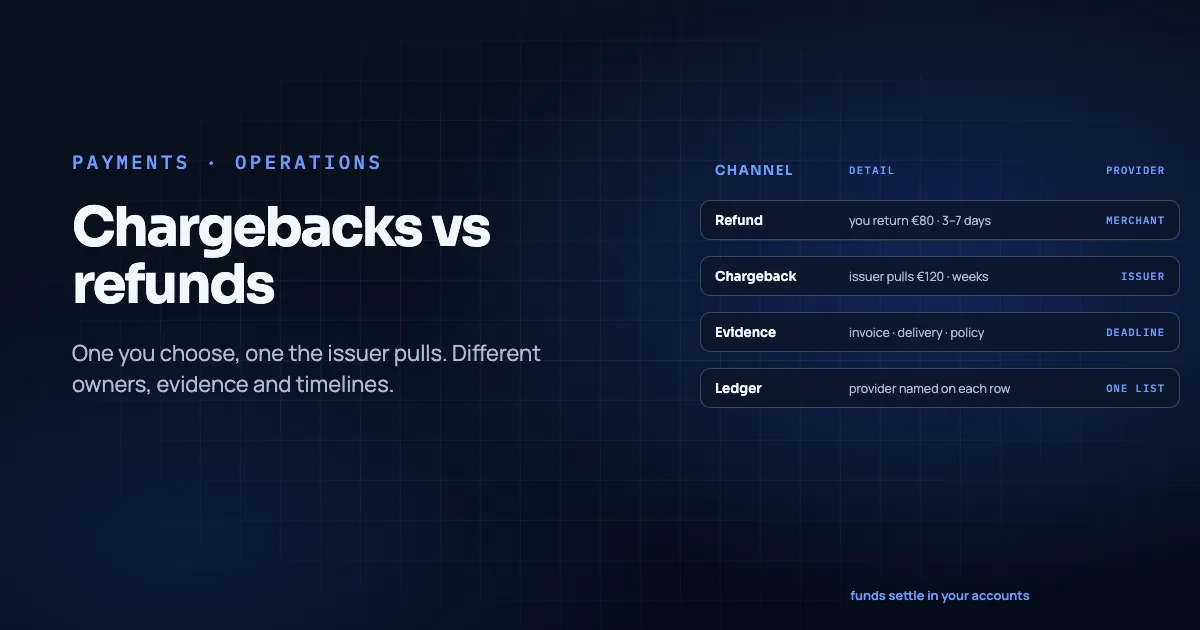
A refund is money your business chooses to return to the customer. A chargeback (card dispute) is money the customer's bank pulls back through the card network after the cardholder files a dispute (Stripe: Chargebacks 101, updated 2026-03-16, retrieved 2026-11-09).
Both can end with the shopper whole. Only one of them is a process you control end to end. This guide is for ecommerce operations, support and finance leads on Shopify, WooCommerce or a custom storefront. It also covers teams that route across more than one payment account and need a single operating picture.
No win-rate percentages or "average chargeback cost" figures are invented here. Use your processor's fee schedule and your own dispute rate.
Key Takeaways
- Refunds are merchant-initiated; chargebacks are issuer-initiated through the dispute process (Stripe).
- On Stripe's card dispute flow, the network pulls dispute funds from the platform. Stripe debits your balance for the disputed amount plus a dispute fee. You generally cannot issue a separate refund while the dispute is open (Stripe Docs: How disputes work).
- Stripe's dispute metrics count disputes on successful payments. A refund is a different event from a dispute (Stripe Docs: Measuring disputes).
- With orchestration, refunds and disputes still belong to the connected account that captured the payment. A unified ledger helps you find the row; it does not merge two processors' dispute queues.
- Temble's ledger supports refunds and exports across channels; custom storefronts receive signed webhooks for payment, refund and dispute events (pricing page, integrations directory, retrieved 2026-11-09).
In this guide
- Side-by-side: who starts it, who controls funds
- Refund ops: keep the conversation
- Chargeback ops: evidence and ownership
- Multi-account reality
- Refund vs chargeback decision tree (ops)
- What finance should see weekly
- Frequently asked questions
- Conclusion
Side-by-side: who starts it, who controls funds
| Refund | Chargeback / dispute | |
|---|---|---|
| Who starts it | The merchant (often after a customer request) | The cardholder via their issuing bank (Stripe) |
| Who controls the money movement | The merchant instructs the processor to return funds | The issuer/network pulls funds into the dispute process (Stripe; Stripe Docs) |
| Typical use | Returns, cancellations, goodwill, wrong item | Unauthorized charge claims, "item not received," quality disputes, etc. |
| Fees | Processor rules vary; often no separate "dispute fee," and original processing fees may not be returned. Read your contract | Dispute fees apply on many processors; Stripe documents debit of disputed amount plus dispute fee (Stripe Docs) |
| Timeline pattern | Stripe's explainer cites a common pattern of roughly 3–7 business days after approval for the refund itself, separate from how long negotiation took (Stripe) | Often weeks to months if contested (Stripe) |
| Network dispute rate | Refunds are not the same metric as disputes | Disputes count toward dispute activity / rate calculations (Stripe Docs: Measuring disputes) |
Stripe's Chargebacks 101 piece states the main difference as which party initiates the reversal, then expands into control, timing and impact (Stripe, retrieved 2026-11-09). Use that as vocabulary, then open your processor's dispute policy for fees in your country.
Refund ops: keep the conversation
Good refund operations are mostly policy and speed:
- Publish a clear return window on the site the shopper actually reads.
- Decide partial vs full rules (used goods, opened software, custom items) before peak season.
- Prefer refund over argument when the cost of winning is a chargeback fee plus lost time. That is a business judgment, not a moral one.
- Refund to the original method unless your processor and finance team have an explicit exception path.
- Log the reason code in the store and in the payment ledger so finance can separate "size exchange" from "quality failure."
On a Temble-connected stack, refund from the same operational surface you trust for reconciliation when you can. Temble's ledger includes refunds and exports across Shopify, WooCommerce and custom channels (pricing page, retrieved 2026-11-09). Confirm how refunds sync back to Shopify or WooCommerce on your connection (integrations directory).
Chargeback ops: evidence and ownership
When a dispute opens, treat it as a timed evidence problem:
- Alert routing. Who gets the processor email or webhook? Name a primary and a backup before BFCM (peak-season checklist).
- Freeze duplicate make-goods. Do not ship a second product and also lose the dispute for lack of tracking.
- Assemble evidence: order invoice, proof of delivery or digital delivery logs, customer communication, product description as shown at purchase, refund policy screenshot.
- Know representment deadlines on that processor. Missing the window is an automatic loss regardless of how right you feel.
- Record the outcome on the order: won, lost, partially reversed.
Stripe's documentation notes that while a dispute is open you cannot issue a refund outside the dispute process for that charge (Stripe Docs: How disputes work, retrieved 2026-11-09). Train support not to promise "I'll just refund it" once a dispute exists. Check the processor state first.
Custom or headless storefronts connected to Temble can receive signed webhooks for disputes as well as payments and refunds (integrations directory, retrieved 2026-11-09). Wire those into the same ticket system that owns customer promises.
Multi-account reality
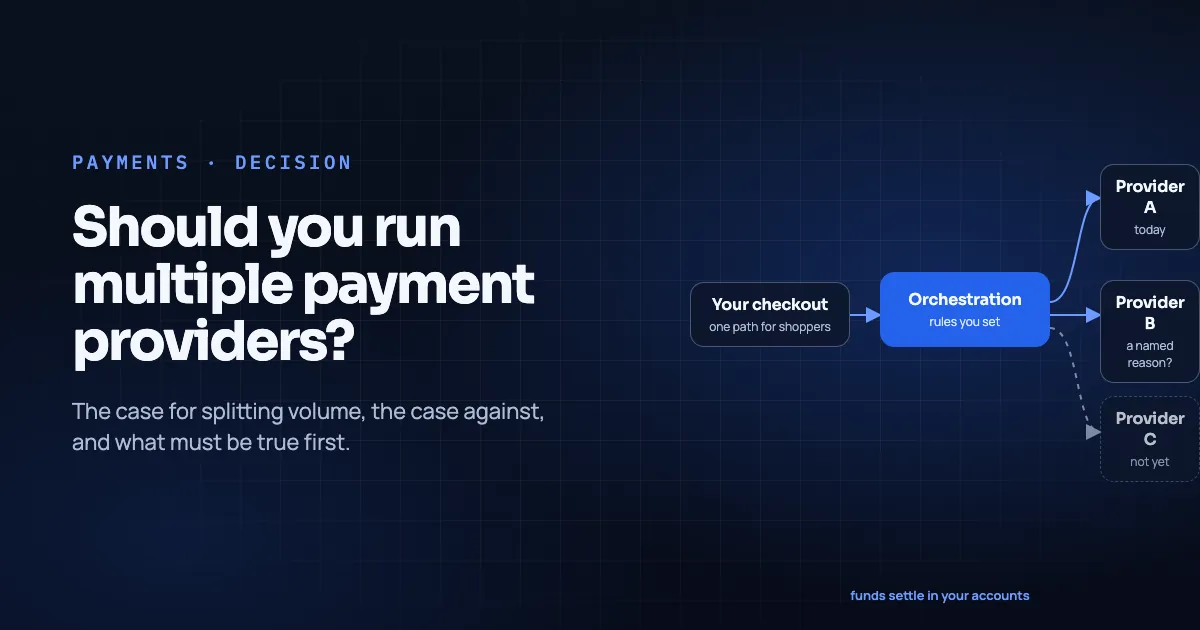
If you split volume across two Stripe accounts, or Stripe and Finix, each dispute lives on the account that acquired the payment. Orchestration did not become the acquirer (What Is a Merchant Acquirer?; integrations directory).
Practical consequences:
- Evidence portals differ per destination.
- Fees and programs differ per destination.
- Your unified ledger should still show which provider took the original payment so agents do not open the wrong dashboard.
Temble's published routing chooses the account before the charge; it does not retry a decline elsewhere (Temble homepage, retrieved 2026-11-09). Chargebacks are a post-capture process on whichever account captured successfully.
Refund vs chargeback decision tree (ops)
Customer unhappy
  → Can you still fix with replacement or partial refund?
      YES → Prefer merchant-controlled refund path; document reason
      NO / customer already filed with bank
          → Check processor: is a dispute already open?
              YES → Do not double-refund; follow dispute evidence path
              NO  → Refund if policy allows; confirm settlement state first
This tree avoids the expensive failure mode: refunding in the store while a dispute also debits the processor balance.
What finance should see weekly
- Refund count and amount by reason and by provider.
- Open disputes, age, and deadline.
- Dispute outcomes for the prior month (won/lost/accepted).
- Matching of ledger exports to payout reports per connected account.
Orchestration earns part of its keep here: one export with shop and provider on each row beats a weekend of CSV merges (What Is Payment Orchestration). It does not remove the need to log into each provider for representment.
Frequently asked questions
Is a PayPal or BNPL "dispute" the same as a card chargeback?
Not always. Card chargebacks follow card-network dispute rules. PayPal and BNPL brands run their own case processes. Treat each method's dispute channel as documented by that provider through your connected account (integrations directory).
Does issuing lots of refunds hurt my dispute rate the same way chargebacks do?
Stripe documents how dispute activity and dispute rate are measured on successful payments (Stripe Docs: Measuring disputes). A refund is not a dispute, so it is not counted there. Refunds are a cost and a signal; they are not the same metric as chargebacks. Read your network monitoring obligations with counsel or your processor's risk team.
Can Temble stop chargebacks?
No honest orchestration layer can. Temble routes and records; risk tools and operational discipline reduce disputes. Anyone promising "we eliminate chargebacks" is selling something else.
Where do funds settle when you refund?
Refunds return through the processor that captured the payment, under that processor's timing. Temble does not hold a merchant balance for your revenue (Temble homepage, retrieved 2026-11-09).
Conclusion
Refunds are a policy tool you drive. Chargebacks are a network process the issuer drives. Ops wins by separating the playbooks, naming owners, and keeping evidence close to the order. That is especially true when more than one payment account is in play.
Use a unified ledger to find the payment fast; use the connected account's dispute tools to fight or accept it. For how those accounts sit under routing, see Payment Gateway vs PSP vs Orchestration Layer.
Questions about refunds and dispute webhooks on your setup: book a 30-minute walkthrough.
About the author. Mattieux Rinot is an SEO Expert at Temble. Temble is a payment orchestration layer that routes payments across a merchant's own accounts and never holds the funds. Mattieux has five years of experience across CRM, customer success and payment processing.
Corrections. Errors go to the contact page; we fix them with a dated update note.
Sources
- Stripe, Chargebacks 101: What they are and how businesses can prevent them, updated 2026-03-16
- Stripe Docs, How disputes work, retrieved 2026-11-09
- Stripe Docs, Measuring disputes, retrieved 2026-11-09
- Temble homepage, pricing page, integrations directory, retrieved 2026-11-09
- What Is Payment Orchestration
- What Is a Merchant Acquirer?