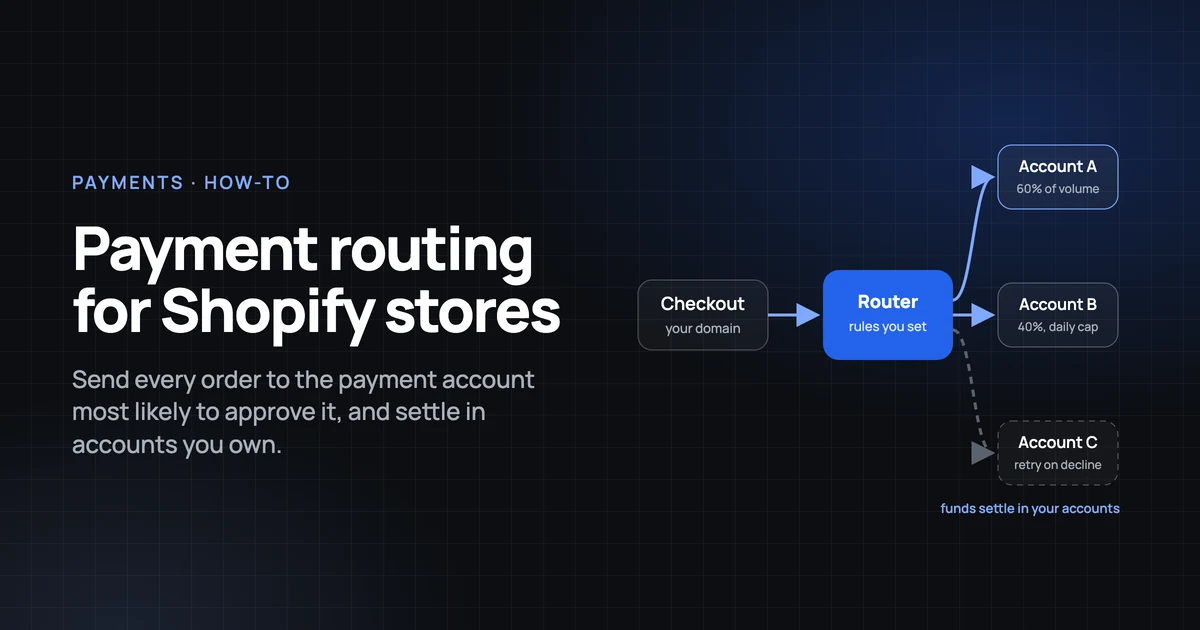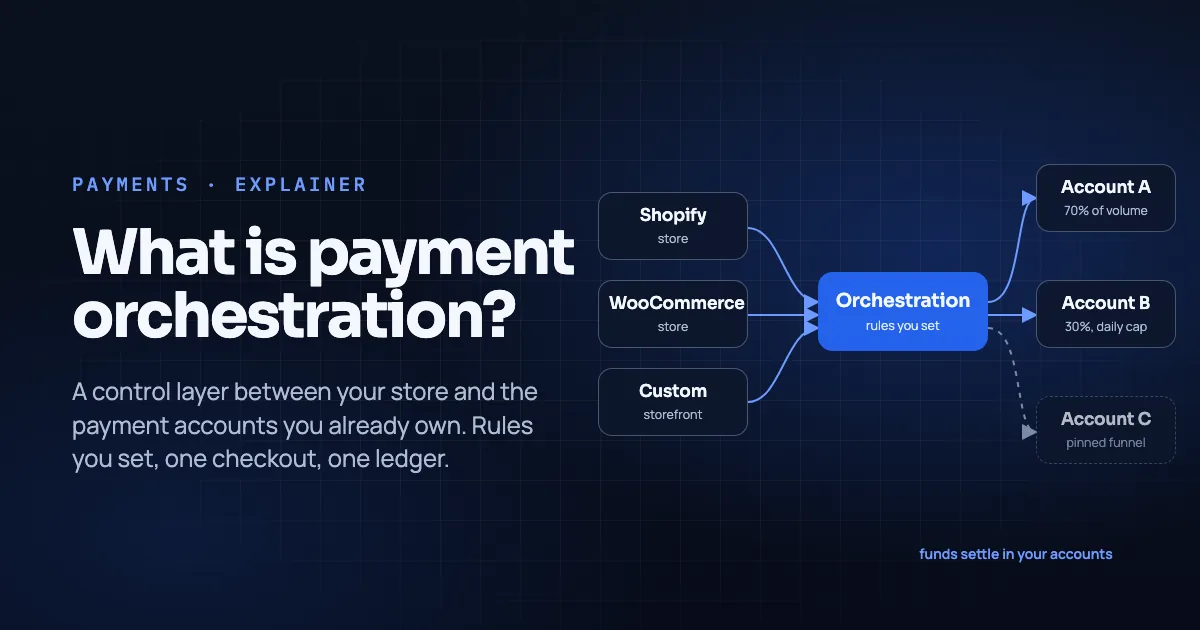
Payment orchestration is a layer between your store and the payment accounts you already run. You write the rules. The layer picks which account attempts each payment. Shoppers check out once. You reconcile in one place.
It is not a second bank account for your revenue, and not a reason to rip out a provider that already works. Most single-market, single-processor stores do not need it. Merchants who already hold several accounts, or who are about to, often do.
This guide is for founders and operations leads on Shopify, WooCommerce or a custom storefront. For the Shopify-specific setup, see How to Set Up Payment Routing on Shopify (2026 Guide).
Key Takeaways
- Payment orchestration sits between your store and your payment providers. It chooses which connected account handles each payment, by rules you control, and gives you one checkout and one ledger across them.
- A payment gateway moves card data. A PSP authorizes, captures and settles. Orchestration decides which of your gateways or PSPs runs the attempt.
- Common rule types are percentage splits, daily caps per account, and pinning a funnel or market to one setup. Cross-account retries after a decline are not universal: ask before you buy.
- A non-custodial layer never holds your funds. Each connected provider pays out to the bank account you linked to it.
- Skip orchestration if one provider covers your markets and reconciliation is already simple. Consider it when volume is split across accounts you cannot see in one place.
In this guide
- What payment orchestration means
- Orchestration vs a single PSP vs a gateway
- What an orchestration layer actually does
- A worked example
- When you need it, and when you do not
- How to evaluate an orchestration layer
- How Temble fits
- Frequently asked questions
What payment orchestration means
Independent advisors describe payment orchestration as deciding how best to route each transaction from checkout to bank settlement, across several PSPs, gateways and acquirers. A specialist middleware vendor can do it, and so can an in-house team or the merchant's own PSP (Edgar, Dunn & Company, Orchestration in IT is not new, 2021-05-02). There is no single industry standard. The useful test is operational: can you change which of your accounts processes an order without rebuilding checkout?
Here is how we describe it in the Temble FAQ: "A layer between your store and your payment providers. It decides which provider takes each payment, by rules you write, and gives you one checkout and one ledger across all of them" (Temble homepage FAQ, retrieved 2026-11-09).
| Term | What it does | What it does not do |
|---|---|---|
| Payment gateway | Encrypts and passes payment data from checkout to a processor | Decide strategy across several of your accounts |
| PSP / processor / acquirer | Authorizes the method, captures the funds, pays out to you | Give you a neutral view across other providers you also use |
| Orchestration / routing layer | Chooses which of your connected accounts attempts the payment | Replace the need for accounts in your own name |
An acquirer is the bank or processor that accepts card payments on your behalf. A PSP packages acquiring, gateway features and often wallets or local methods into one commercial relationship. Orchestration sits one level above that relationship when you have more than one.
Orchestration vs a single PSP vs a gateway
Hard-wiring checkout to one PSP is the default for a reason: one onboarding, one support inbox, one payout report. For a store that sells mainly in one currency through one provider, that default is usually correct.
The trade-off appears when you outgrow a single relationship:
- A second account for a new market, risk profile or volume commitment splits checkout, refunds and reporting across two admin panels.
- Your storefront limits how you attach card processors. Shopify allows one credit card payment provider at a time (Shopify Help: Configuring third-party providers, retrieved 2026-11-08). Splits, caps and per-funnel routing live inside that card slot, or inside a routing layer that fills it. See the Shopify routing guide.
- Finance wants one export that names the channel and the provider on every row, and nobody can produce it without a weekend of spreadsheets.
A gateway is plumbing for a single path. A second PSP does not help unless something chooses the path and consolidates the result. Orchestration is that decision layer. It does not replace accounts in your name. It makes those accounts usable from one storefront integration. For a fuller map of the three roles, read our guide to the payment gateway vs PSP vs orchestration layer.
What an orchestration layer actually does
Feature lists vary. Press vendors on the points below. Where Temble's public pages state a behavior, that is called out.
Routing rules, before the charge. Typical types are percentage splits across accounts and daily caps that spill to the next account you named. Pins send a funnel, market or campaign to one setup. Temble's rules match that set: percentage splits across connected payment setups, daily caps per setup, or a funnel pinned to one setup. The route is chosen before the charge (Temble homepage FAQ, retrieved 2026-11-09).
Hosted checkout on your domain. Temble serves checkout from your own subdomain, from the card form through the thank-you page. That holds for Shopify, WooCommerce and custom storefronts. Card numbers are collected by the processor's fields, not by Temble servers (Temble homepage FAQ, retrieved 2026-11-09).
One ledger across channels. Centralized reporting is often the part merchants feel first. It is a common reason to look at orchestration (Edgar, Dunn & Company, 2021). Temble's dashboard shows revenue, orders, top countries and payment-method breakdowns. Its transaction list tags every payment with its sales channel: Shopify, WooCommerce or custom (Temble homepage FAQ, retrieved 2026-11-09).
Retries and failover: ask, do not assume. Some products retry a soft decline on a second account. Others do not. Temble does not retry a declined card on another account today. You choose the route before the charge. The shopper sees the result of that route (Temble homepage, "On a decline", retrieved 2026-11-09). If automatic cross-account retries are a requirement, verify them in a sandbox.
Non-custodial settlement. In a non-custodial model, each connected provider pays out to the bank account you linked to it. The orchestration layer never holds a merchant balance.
Temble's public position is explicit. It never holds, custodies or pools merchant funds. Payments settle directly into your own account. The processing fee is taken as an application fee on the payment itself, so your revenue never passes through a Temble bank account (Temble homepage FAQ, retrieved 2026-11-09).
If a vendor settles to you from its bank account, you are using a custodial processor under another name. That can be valid. It is a different risk and a different contract.
A worked example
You hold Account A (US acquiring) and Account B (EU acquiring), used by a Shopify store and a WooCommerce store. Rules, in order; the first matching rule wins:
- EUR or EU-shipping orders go to B.
- Everything else splits 70% to A and 30% to B.
- B caps at €25,000 per day, then spills to A.
- A campaign funnel is pinned to A for the weekend.
An order for €120 shipping to Berlin hits rule 1 and goes to B. B has processed €18,400 today, under the cap. B approves. Funds settle into the bank account linked to B. One ledger row shows the Shopify channel and Account B.
If B had declined the card, under Temble's published behavior the shopper would see the decline, with no automatic retry on A. Another vendor might offer that retry; measure it separately.
The example shows mechanics only. It does not predict an authorization rate, a fee saving or a conversion lift.
When you need it, and when you do not
Consider orchestration when:
- You already hold two or more payment accounts and reconcile them by hand.
- Volume or risk must be split with caps, percentages or pins.
- More than one sales channel should share one routing policy and one transaction list.
- A second account you already own is unreachable from checkout.
- Finance needs one export with provider, channel and payout reference on every row.
You probably do not need it yet when:
- One provider covers the countries and methods you sell.
- The only pain is wanting a lower rate. That is a commercial conversation, not a routing project.
- You have no second account and no concrete reason to open one.
- Nobody will own rules and weekly reconciliation after go-live.
- You mainly need a prettier checkout on a single PSP.
Edgar, Dunn & Company makes a similar point: payments orchestration "is not suitable for all types of merchants" (EDC, 2021-05-02). The first question to answer is your strategy for payments. If you are weighing a second provider, start with our checklist for running multiple payment providers.
How to evaluate an orchestration layer
- Custody. Do funds settle only into bank accounts you own at each provider? Is there a vendor balance?
- Rule types. Splits, caps, pins, fallbacks: which exist today, and are they evaluated before the charge?
- Decline behavior. Retry elsewhere, fail over, or show the decline? Verify in a sandbox.
- Checkout. Card form on your domain or subdomain? Who is in PCI scope for card fields?
- Ledger. Every channel and provider in one list, with exports that match payouts?
- Store fit. Native Shopify and WooCommerce paths? Signed API and webhooks for custom storefronts?
- Methods. Which wallets, BNPL options and local methods come from the connected account versus the vendor's marketing page? Check the integrations directory.
- Commercial shape. Platform fee versus per-transaction fee, and what is included. Use Temble pricing as one data point, not a category benchmark.
- Ownership. Who on your side owns rules and weekly reconciliation after go-live?
If a vendor cannot answer custody, decline behavior and ledger matching without marketing adjectives, keep looking.
How Temble fits
Temble is a payment orchestration layer for Shopify, WooCommerce and custom storefronts. It connects the store and the payment accounts you already run. You write the rules. Shoppers pay on your subdomain. Money settles in your accounts, never in a Temble account (Temble homepage, retrieved 2026-11-09).
Published scope, as of the pages retrieved for this article:
- Routing: percentage splits, daily caps per setup, funnel pins; the route is chosen before the charge.
- Declines: shown to the shopper; a card is not sent on to another merchant account.
- Checkout: hosted on your subdomain with your published design; the processor's fields collect card data.
- Reporting: revenue, orders, top countries, payment methods, and a transaction list with the sales channel on every payment.
- Commercial: $99 a week for the platform, whatever your volume, plus processing from 2.9% + $0.29 per successful transaction depending on your business type. No setup fee (pricing page, retrieved 2026-11-09).
- Connections: Shopify and WooCommerce integrations, and custom or headless storefronts through the checkout API (integrations directory).
Agencies and platforms can look at the partner program. Temble will not invent a second acquiring relationship, promise an authorization lift here, or retry a decline onto another account. If those are the jobs you need, tell any vendor, including us, before you sign.
Frequently asked questions
Is payment orchestration the same as a payment gateway?
No. A gateway moves payment data for a path you already chose. Orchestration chooses which of your connected paths to use, under rules you control, and usually adds a unified view of the result.
Do I need orchestration if I only use one PSP?
Usually not. Open a second account only when there is a concrete reason, such as a market, a risk profile, volume or resilience. Then decide whether rules and a shared ledger justify a layer on top.
Will orchestration raise my authorization rate?
Nobody can promise that for your store from a blog post. Measure your own baseline first. Treat vendor averages as their population, not yours.
Does an orchestration layer hold my money?
It should not, if it is non-custodial. Temble never holds, custodies or pools merchant funds, and your revenue never passes through a Temble bank account (Temble homepage FAQ, retrieved 2026-11-09). If a vendor pays you from its own account, read that contract as custody.
How is this different on Shopify versus WooCommerce?
The job is the same: rules, checkout, ledger. The platform constraints differ. Shopify's card settings are built around a primary provider model. WooCommerce is plugin-based and more flexible about stacking gateways, with its own reconciliation cost. Start with the Shopify routing guide if that is your storefront. If you run WooCommerce, start with the WooCommerce routing guide instead.
When orchestration earns its place
Payment orchestration is a control layer. It earns a place when you already run, or must run, more than one payment account. You then need rules, a branded checkout and one ledger, without giving a vendor custody of your funds.
If a single provider still covers the business, keep the architecture boring. If the spreadsheets and the second merchant account are already real, use the checklist above and make vendors answer it in a sandbox.
To see splits, caps and pins on a live store setup, book a 30-minute walkthrough with the Temble team.
About the author. Mattieux Rinot is an SEO Expert at Temble. Temble is a payment orchestration layer that routes payments across a merchant's own accounts and never holds the funds. Mattieux has five years of experience across CRM, customer success and payment processing.
Corrections. If you find an error in this guide, tell us through the contact page. We fix it and add a dated update note.
Sources
- Temble homepage FAQ: "What is payment orchestration?", "Does Temble hold or custody my funds?", "How does payment routing work?", "Which platforms does Temble connect to?", "What reporting and analytics do I get?", and the "On a decline" section, retrieved 2026-11-09
- Temble pricing, platform fee and processing rates, retrieved 2026-11-09
- Temble integrations, store connections and payment methods, retrieved 2026-11-09
- Temble blog: How to Set Up Payment Routing on Shopify (2026 Guide), 2026-11-08
- Shopify Help: Configuring third-party payment providers, one credit card provider at a time, retrieved 2026-11-08
- Edgar, Dunn & Company, Orchestration in IT is not new, so why do merchants believe Payments Orchestration is a new paradigm?, 2021-05-02