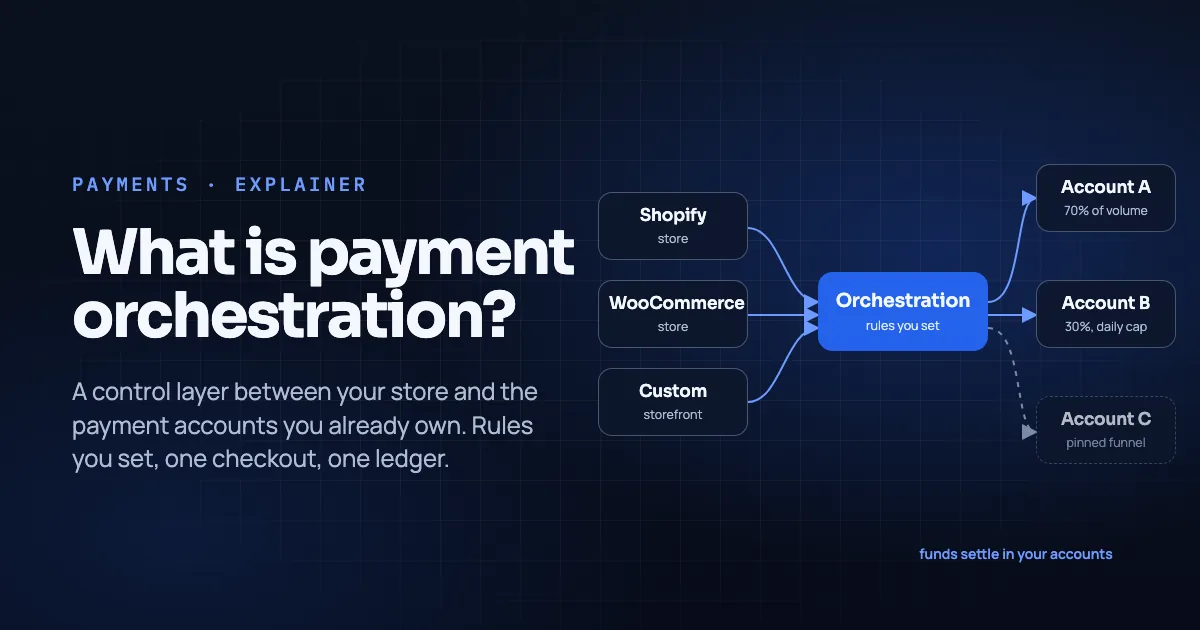
A payment gateway moves card data from your checkout to a processor. A payment service provider (PSP) authorizes and settles the payment, often with acquiring built in. An orchestration layer sits above the accounts you already hold and chooses which one attempts each payment.
Vendors reuse these words until they blur. This guide maps the actors in a card payment, then places the three products you will meet on sales calls on that map. It is for founders and operations leads on Shopify, WooCommerce or a custom storefront who need the vocabulary before they change a provider.
For when orchestration is worth buying, see What Is Payment Orchestration? A Merchant Guide (2026). For Shopify's provider slot, see How to Set Up Payment Routing on Shopify (2026 Guide).
Key Takeaways
- A payment gateway securely transmits payment data from checkout toward a processor, the digital equivalent of a card terminal (Stripe, updated 2026-05-11).
- A processor authorizes the attempt between the issuing and acquiring banks. An acquirer provides the merchant account and settles into it. Many brands do both (Stripe, updated 2025-04-25).
- A PSP combines gateway and processor into one service, often with acquiring (Stripe, PSP section).
- An orchestration layer sits above accounts you already hold. It chooses which connected provider attempts each payment. Temble's version also gives you one checkout and one transaction list.
- Ask every vendor three questions. Do you move the card data? Do you authorize and settle into an account in my name? Or do you only choose which of my accounts runs the attempt?
In this guide
- The cast: who is in a card payment
- One payment, drawn as a path
- Payment gateway: the bridge
- Processor, acquirer and PSP: who moves the money
- Orchestration layer: the chooser above your accounts
- Payment gateway vs PSP vs orchestration layer, side by side
- Three confusions that waste a week
- How to read a vendor homepage
- Frequently asked questions
- Which layer you are actually buying
The cast: who is in a card payment
The roles below follow Stripe's explainers on processors and gateways and processors and acquirers, both retrieved 2026-11-09.
| Actor | Plain job |
|---|---|
| Shopper (cardholder) | Pays with a card or wallet. Holds the relationship with the issuer. |
| Merchant | Sells the goods. Owns the storefront and the commercial risk of delivery, refunds and disputes. |
| Payment gateway | Encrypts and transmits payment data from the checkout (or terminal) toward the processor. A bridge, not a bank. |
| Payment processor | Takes the encrypted attempt, talks to the banks and networks, and returns approve or decline. |
| Acquirer (acquiring bank) | Lets the merchant accept cards: merchant account, network membership, settlement into that account, and the chargeback and fraud risk. |
| Card network | Visa, Mastercard, American Express, Discover and peers. Rulebooks and rails between acquirer and issuer. |
| Issuer (issuing bank) | The bank that issued the shopper's card. Approves or declines against the cardholder's account. |
| Orchestration / routing layer | Optional. Sits between the store and one or more of the merchant's gateways or PSPs. Chooses which connected account attempts the payment, under rules the merchant wrote. |
Two caveats. First, one company can wear several hats. Stripe notes that many providers bundle gateway and processor, and that Stripe itself acts as both processor and acquirer (Stripe, updated 2025-04-25). Second, wallets and local payment methods add actors. The card path is still the clearest way to learn the vocabulary.
One payment, drawn as a path
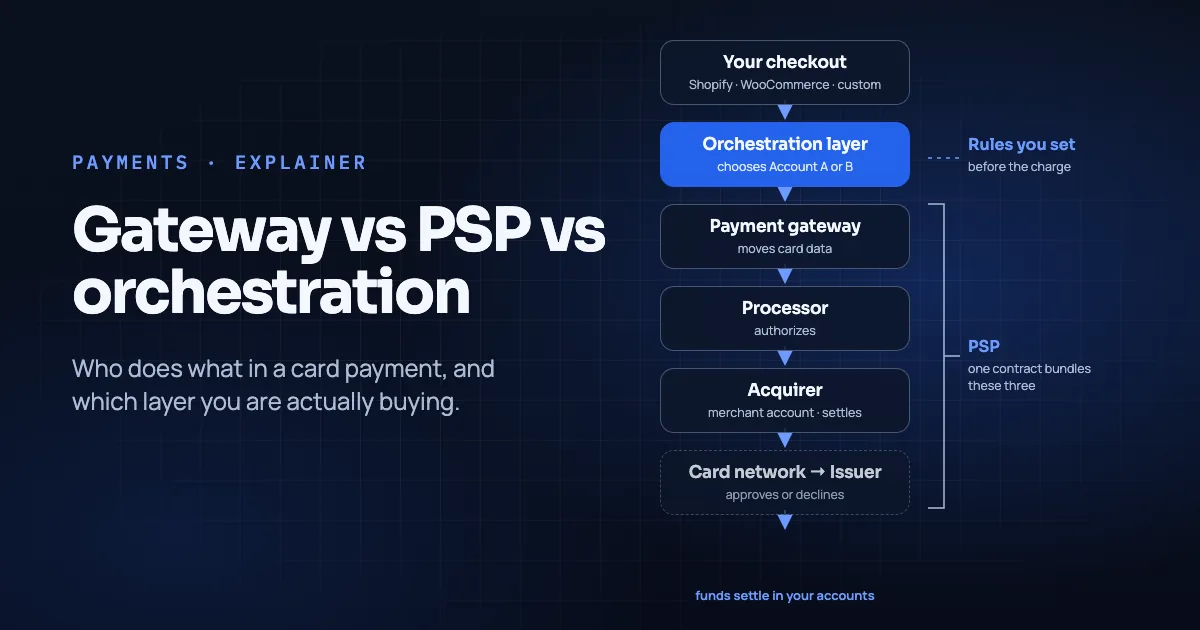
In words: card data goes from checkout through gateway, processor and acquirer to the network and the issuer. The answer comes back the same way. A classic split-stack card payment looks like this:
Shopper
→ Merchant checkout (your store)
  → Payment gateway (encrypts and sends card data)
    → Payment processor
      → Acquirer
        → Card network (e.g. Visa)
          → Issuer (shopper's bank): approve or decline
← the result travels back the same way to the checkout
If the issuer approves, settlement follows later: issuer, network, acquirer, merchant account, then a payout to the merchant's bank. Stripe's explainer says this usually takes several business days. Read that as a pattern, not a promise for your account (Stripe, updated 2026-05-11).
A PSP collapses several middle boxes into one contract. An orchestration layer adds a choice step before the gateway or PSP path:
Shopper → Merchant checkout
→ Orchestration layer (picks Account A or Account B by rule)
  → Account A's gateway / PSP / acquirer stack → network → issuer
  or
  → Account B's gateway / PSP / acquirer stack → network → issuer
The issuer still approves or declines. Orchestration did not replace the banks or the network. It chose which of your stacks made the attempt.
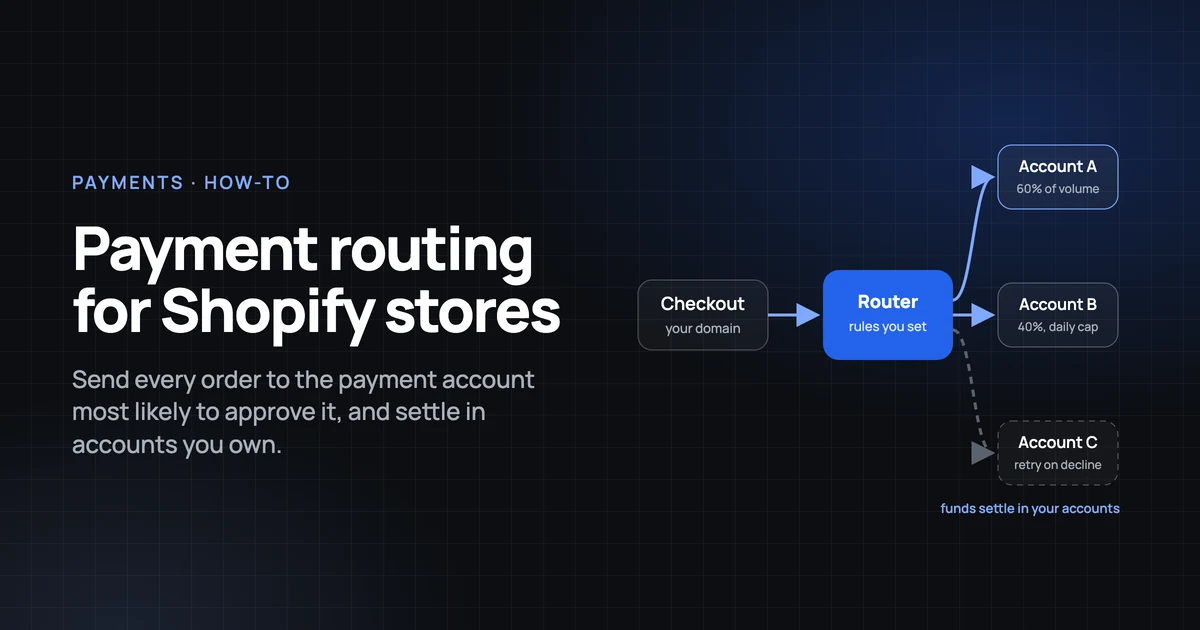
A concrete case. Order 1042, €80, from the Shopify channel. Your rule splits volume 70/30 between Account A and Account B, and this order lands on A. The choice is made before the charge. A's processor fields collect the card. A's acquirer settles the money into the bank account you linked to A, and the ledger row shows the Shopify channel and Account A. If A declines, the shopper sees the decline, and nothing is retried on B.
Payment gateway: the bridge
A payment gateway securely transmits payment information between the customer, the business and the payment processor. Stripe calls it the digital equivalent of a point-of-sale terminal (Stripe, updated 2026-05-11).
In practice it collects or receives card or wallet data, encrypts it, and forwards it to whoever authorizes the payment. It then returns approve or decline to the storefront. Alone, it does not choose among several merchant accounts, underwrite you, or reconcile two PSPs you also use.
Gateways often charge setup fees or a monthly subscription for the connection. Processors more often charge a percentage or a fee per transaction (Stripe). In the wild those shapes are frequently bundled, so read the contract.
Processor, acquirer and PSP: who moves the money
Processor. Facilitates electronic transactions between customers and businesses. It acts as the intermediary between the issuing bank and the acquiring bank, so an approved payment can move toward the merchant account (Stripe, updated 2026-05-11).
Acquirer. Establishes and maintains the merchant account, handles authorization and settlement with the issuing bank, and assumes the risk of chargebacks, fraud and disputes (Stripe, updated 2025-04-25).
PSP. Combines gateway and processor into one service (Stripe, PSP section). Some PSPs also act as the acquirer, so you do not open a separate acquiring-bank relationship (Stripe).
An operational test:
- One contract, one dashboard, one payout schedule: usually a PSP, possibly with acquiring built in.
- A thin API that only pipes card data to someone else who pays you: closer to a standalone gateway.
- A bank-led merchant account at the center of the deal: acquiring is the product.
Vendors will still say "gateway" for the whole stack. Ask where the merchant account lives and whose name is on the payout.
Orchestration layer: the chooser above your accounts
An orchestration layer, also called a routing layer, sits between the store and the payment accounts you already run. In the Temble FAQ it is "A layer between your store and your payment providers. It decides which provider takes each payment, by rules you write, and gives you one checkout and one ledger across all of them" (Temble homepage FAQ, retrieved 2026-11-09).
| PSP | Orchestration layer | |
|---|---|---|
| Primary job | Authorize, capture and settle, often through its own acquiring | Choose which of your connected accounts attempts the payment |
| You hold | One relationship with that PSP | The underlying accounts, plus the orchestration contract |
| Money | That PSP's payout model | Non-custodial: each connected provider pays out to the bank account you linked to it |
| Best fit | Single-stack simplicity | Multi-account control without rebuilding checkout |
Temble's published shape, in brief (details on the pricing page):
- Rules before the charge: percentage splits, daily caps per setup, a funnel pinned to one setup.
- Checkout on your subdomain, with card data collected by the processor's fields, not by Temble servers.
- One dashboard, with a transaction list that tags every payment with its sales channel.
- No Temble balance: Temble never holds, custodies or pools merchant funds, and your revenue never passes through a Temble bank account.
- A declined card is shown to the shopper and is not sent on to another merchant account (Temble homepage, "On a decline", retrieved 2026-11-09).
If a product settles your sales from its bank account into yours, it is a custodial PSP or a payfac-style model. It is not a pure chooser. Both can be legitimate. They are not the same risk.
Payment gateway vs PSP vs orchestration layer, side by side
| Question | Gateway | PSP (often with acquiring) | Orchestration layer |
|---|---|---|---|
| Moves card data securely from checkout? | Yes, that is the core job | Yes, usually built in | Hosts the checkout page; card data goes to the connected processor's fields |
| Authorizes and settles the payment? | No, not alone | Yes | No, the connected account does |
| Holds or underwrites the merchant account? | No | Often yes | No, in a non-custodial design |
| Chooses among several of your accounts? | No | Only inside that PSP's own routing, if any | Yes, that is the point |
| Gives one transaction list across other brands you use? | No | No | Yes, when built for it |
On Shopify, remember the storefront constraint: Shopify allows one credit card payment provider at a time (Shopify Help: Configuring third-party providers, retrieved 2026-11-08). A routing layer that fills that slot is how multi-account rules show up there. The Shopify routing guide covers the mechanics.
Three confusions that waste a week
"Our new gateway will raise authorization rates." A gateway moves data. Issuers decide authorization. Do not buy a pipe expecting a risk engine.
"Orchestration replaces our PSP." It does not. Without destinations, meaning accounts in your name, there is nothing to orchestrate. See the orchestration guide for when the chooser layer is worth the complexity.
"PSP, payfac, acquirer, processor: same thing." Full-stack PSPs often combine hats. Stripe's ecosystem overview describes payfacs, "also known as payment service providers", as a way to accept payments without a direct acquiring-bank relationship (Stripe, updated 2026-04-20). If custody matters, ask where the merchant account of record sits.
How to read a vendor homepage
Use this five-minute pass before a demo:
- Find the merchant account. Is it theirs, yours at a bank, or yours at a named PSP they connect?
- Find the payout. Whose bank account sends you money?
- Find the card fields. Whose PCI scope collects the card number?
- Find the choice. Can the product send order 1 to Account A and order 2 to Account B under rules you edit?
- Find the ledger. Can you see every channel and every connected provider in one transaction list?
Temble's public answers, in the same order (Temble homepage FAQ, pricing, integrations, retrieved 2026-11-09):
- Merchant account: your connected accounts, in your name.
- Payout: each connected provider pays the bank account you linked to it.
- Card fields: the processor's, not Temble's.
- Choice: yes, with splits, caps and pins, decided before the charge.
- Ledger: one transaction list across channels.
Compare any other vendor the same way.
Frequently asked questions
Do I need a separate gateway if I already have a payment service provider (PSP)?
Usually no. Many PSPs include gateway functionality in the same platform (Stripe). You add a standalone gateway when a specific storefront, region or hardware path requires it.
Do I need a separate acquirer if I use a full-stack PSP?
Often no. Some PSPs act as both processor and acquirer, so you do not maintain a separate acquiring-bank relationship (Stripe). Confirm it in the contract; the homepage abbreviation is not enough.
Is Temble a PSP or a gateway?
Neither. Temble describes itself as payment orchestration: routing rules, a hosted checkout on your subdomain, and one dashboard across channels. There is no Temble balance for your revenue (Temble homepage FAQ, retrieved 2026-11-09). Authorization and settlement happen on the connected accounts.
Where do Apple Pay and Google Pay fit?
They sit on top of a card or network-token path. You still need a provider that accepts the wallet, and the issuer still authorizes. Orchestration can choose which connected account takes that attempt, subject to what each account enables. See the integrations directory.
Which layer you are actually buying
A gateway moves payment data. A processor and an acquirer, often packaged as a PSP, authorize and settle. An orchestration layer chooses which of your connected stacks runs the attempt and shows them in one place.
Keep the architecture boring when one PSP is enough. Add the chooser when you hold more than one destination and need rules across them.
To see routing on connected accounts in practice, book a 30-minute walkthrough, or start with the orchestration guide.
About the author. Mattieux Rinot is an SEO Expert at Temble. Temble is a payment orchestration layer that routes payments across a merchant's own accounts and never holds the funds. Mattieux has five years of experience across CRM, customer success and payment processing.
Corrections. If you find an error in this guide, tell us through the contact page. We fix it and add a dated update note.
Sources
- Stripe, Payment processor vs. payment gateway, updated 2026-05-11 (gateway, processor and PSP definitions; fee shapes; settlement timing)
- Stripe, Payment processor vs. merchant acquirer, updated 2025-04-25 (acquirer roles; providers that are both processor and acquirer)
- Stripe, The payment industry ecosystem explained, updated 2026-04-20 (card networks, issuers, payfacs and PSPs)
- Shopify Help: Configuring third-party payment providers, one credit card provider at a time, retrieved 2026-11-08
- Temble homepage FAQ: "What is payment orchestration?", "Does Temble hold or custody my funds?", "How does payment routing work?", "What reporting and analytics do I get?", and the "On a decline" section, retrieved 2026-11-09
- Temble pricing and Temble integrations, retrieved 2026-11-09
- Temble blog: What Is Payment Orchestration? A Merchant Guide (2026), 2026-11-09
- Temble blog: How to Set Up Payment Routing on Shopify (2026 Guide), 2026-11-08