Running two payment providers sounds like sophistication. Sometimes it is just two dashboards and a spreadsheet.
This article is for merchants who already wonder whether a second Stripe account, a second processor, or a second acquiring path is worth the complexity. It is also for agencies advising them. It pairs with What Is Payment Orchestration and Payment Gateway vs PSP vs Orchestration Layer. It does not claim that splitting volume raises authorization rates by any particular percentage.
Key Takeaways
- Split volume when you have a named reason: market coverage, risk isolation, volume commitments, method coverage, or resilience you can operate.
- Do not split volume to chase a blog-post authorization lift, or because a vendor demo looked busy.
- Each provider still needs onboarding, payout reconciliation, dispute ops and method configuration. Orchestration reduces storefront glue; it does not delete those jobs.
- Temble routes across connected accounts (Stripe and Finix listed Live today) with splits, daily caps and funnel pins. It does not hold funds and does not retry declines on another account (integrations directory; Temble homepage, retrieved 2026-11-09).
- If one provider still covers countries, methods and risk appetite, keep the architecture boring.
In this guide
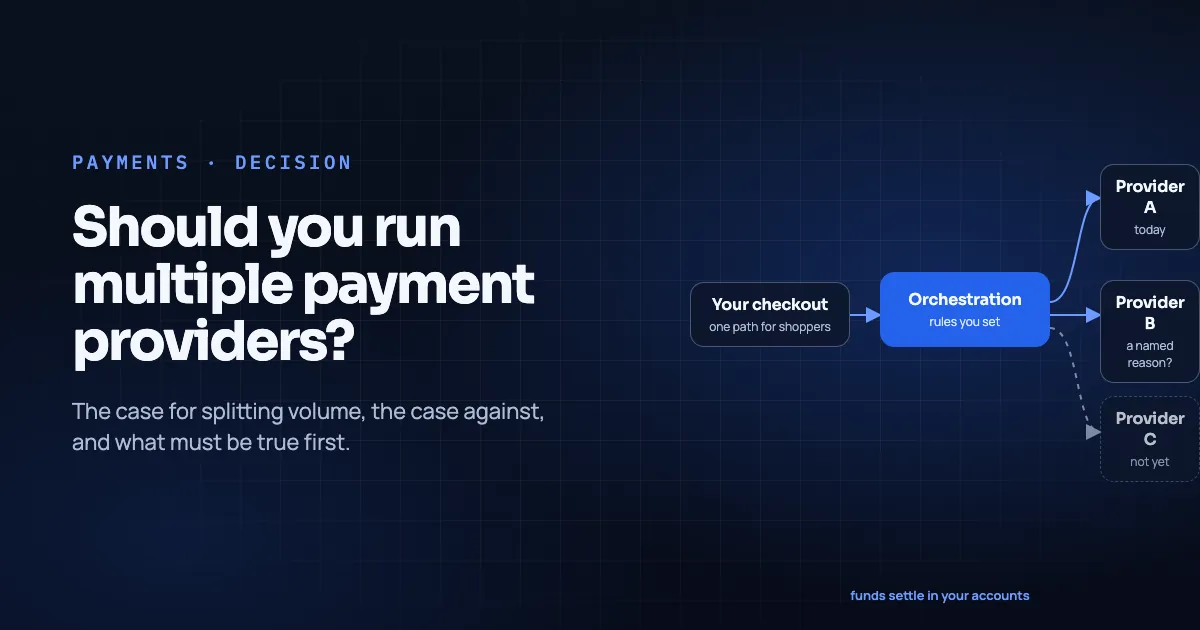
- What "multiple providers" means here
- The case for splitting volume
- The case against splitting volume
- Decision checklist
- How non-custodial routing changes the math
- Agency note
- Frequently asked questions
- Conclusion
What "multiple providers" means here
In this guide, multiple payment providers means more than one commercial destination that can capture shopper payments into accounts in your name. Examples: two Stripe accounts under different entities, or Stripe plus Finix, each with its own payout bank and risk profile.
It does not mean:
- Installing five WooCommerce gateway plugins that nobody reconciles.
- Adding a wallet button (that is still usually one underlying account; see Wallets at Checkout).
- Switching brands every quarter without migrating history.
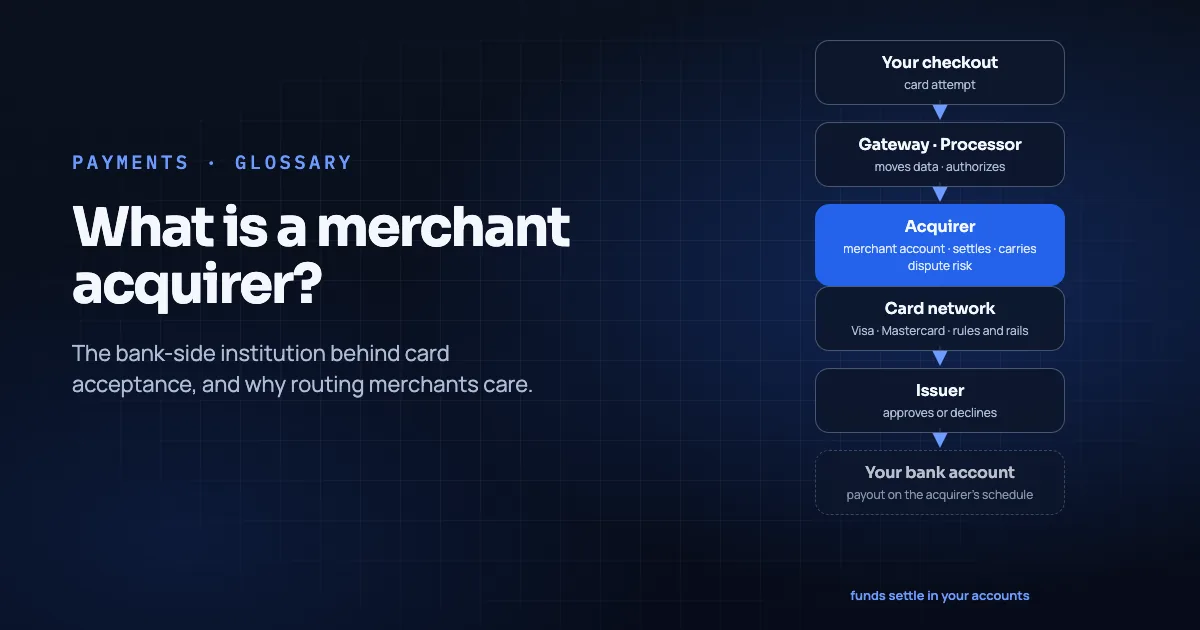
Acquiring vocabulary (who actually holds the merchant relationship) is covered in What Is a Merchant Acquirer?.
The case for splitting volume
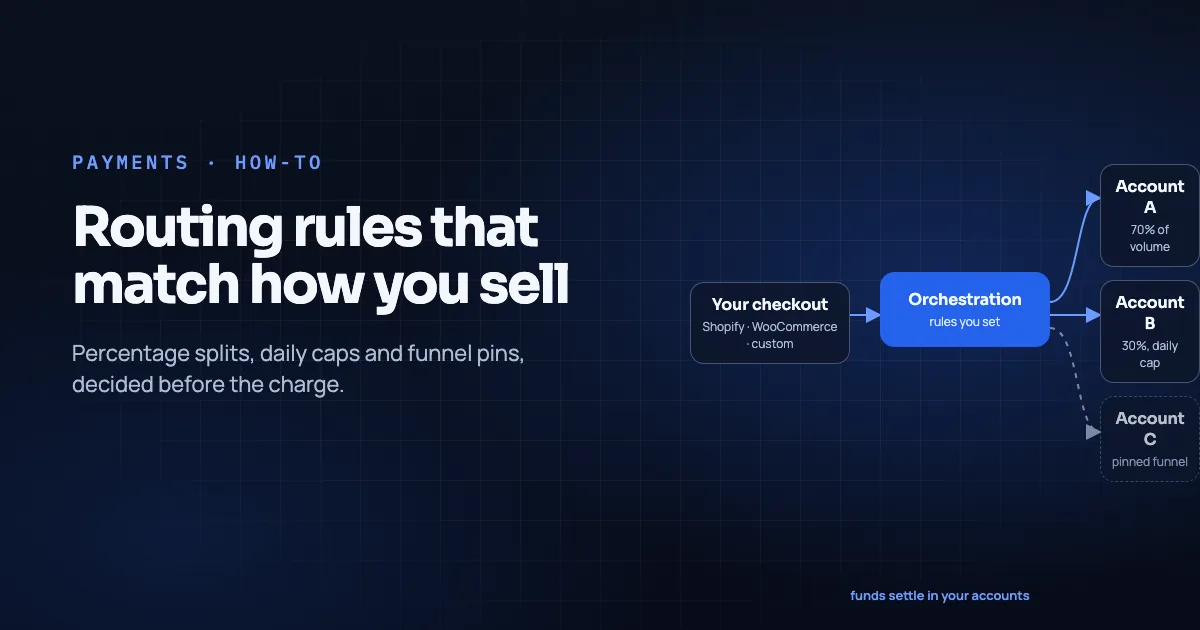
1. Market or entity coverage. EU entity on one account, US entity on another; or a marketplace region that a single account cannot underwrite. Routing can send EUR/EU-shipping to account B and leave the rest on A. That is mechanics only, not a promised approval rate (orchestration guide example pattern).
2. Risk isolation. A higher-dispute product line on its own MID so a blow-up does not freeze the core fashion catalog. Daily caps are a related control: protect a limit, then spill (Temble homepage, retrieved 2026-11-09).
3. Volume or commercial commitments. You signed for a volume tier on account A and need overflow on B without rebuilding checkout. Percentage splits make that policy visible.
4. Method coverage. BNPL or a wallet enabled on one connected account but not the other. The integrations directory lists Klarna, Afterpay, Affirm, Apple Pay and Google Pay as via your account. Pin the funnel that needs the method to the account that has it.
5. Resilience with eyes open. A second live account can reduce single-vendor operational risk (outage, sudden risk appetite change). Resilience only works if the second account is fully boarded, funded for reserves if any, and reachable from checkout before the incident. A paper MID is not resilience.
6. One ledger across channels. Shopify and WooCommerce may already split brain across two processors. If so, a routing layer with one transaction list may be the first time finance sees reality in one export (pricing page, retrieved 2026-11-09).
The case against splitting volume
1. You do not have a second account yet. Open one only with a reason. Orchestration cannot route to a fantasy MID.
2. The only pain is price. Rate shopping is a commercial negotiation. Adding a provider "to get leverage" without capacity to operate two stacks often costs more in ops than it saves.
3. Nobody will own rules. Orphaned percentage splits drift. Caps expire in the wrong timezone. Peak season then fails loudly (peak-season checklist).
4. Reconciliation is already broken on one provider. Two providers multiply the break. Fix payout matching first.
5. You expected automatic cross-account retries. Some products offer them. Temble does not: a declined card is shown to the shopper and not sent on to another account (Temble homepage, retrieved 2026-11-09). If failover retries are the entire business case, verify that behavior in whatever vendor you shortlist. Do not assume.
6. Storefront constraints. Shopify's card settings are built around a primary provider model; multi-account strategy has to respect that slot. See the Shopify routing guide.
Decision checklist
Answer yes/no in writing:
- Do we already hold two accounts (or have approved applications)?
- Can we name the reason for each account in one sentence?
- Who owns routing rules after go-live?
- Can we match last week's payouts from each account to order rows today?
- Are dispute owners trained on both provider portals?
- Do methods we market (wallets, BNPL) exist on the accounts we will route to?
- Have we tested approve, decline, refund on each destination?
- Do we accept the published decline behavior of our routing layer?
If you cannot clear (1)–(4), stop. If you clear them and still need a chooser above the accounts, read the orchestration evaluation list.
How non-custodial routing changes the math
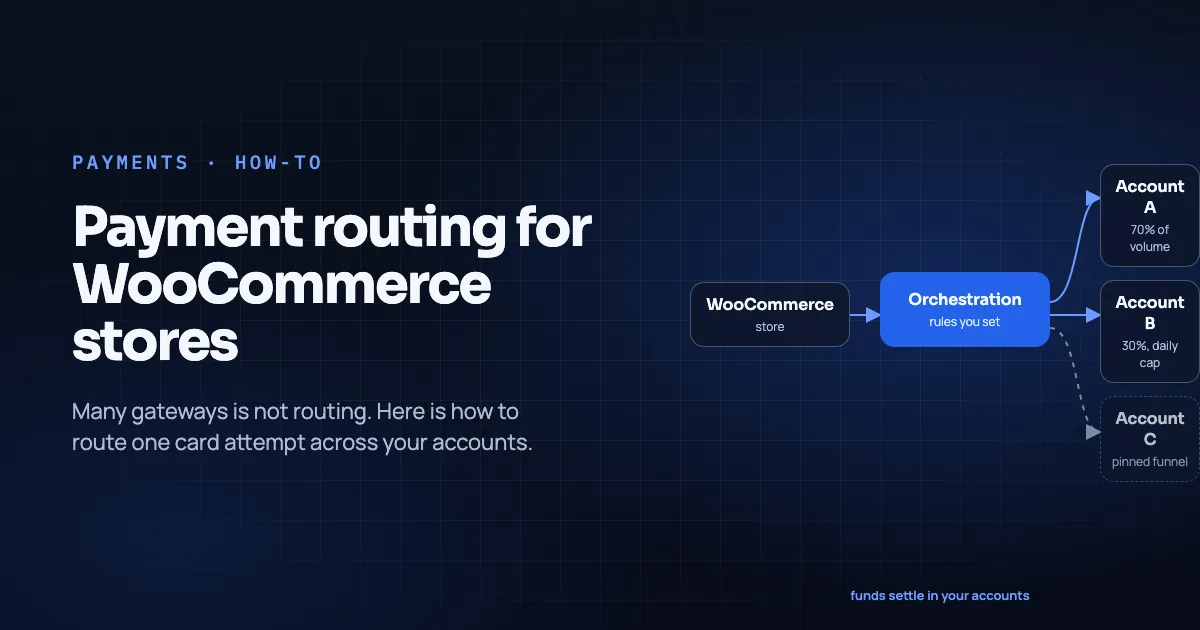
Without a routing layer, "multiple providers" often means multiple checkouts or brittle theme logic. With a layer like Temble:
- Shoppers pay once on your subdomain checkout.
- Rules pick the connected account before the charge.
- Funds settle in those accounts; Temble does not hold a merchant balance (Temble homepage, retrieved 2026-11-09).
- Connectable processors listed Live: Stripe, Finix (integrations directory, retrieved 2026-11-09).
- Platform fee publicly listed at $99 per week plus processing per successful transaction; no setup fee (pricing page, retrieved 2026-11-09).
You still pay for, and operate, each underlying provider. Orchestration is additive complexity that removes storefront complexity. Run that trade consciously.
Agency note
If you advise merchants, do not sell "multi-PSP" as a default package. Sell a written reason, a rule draft, a reconciliation drill and a decline-behavior demo. The agency playbook covers migration framing without invented case studies. Partner tracks for agencies are listed on the partner program page.
Frequently asked questions
Is two Stripe accounts "multiple providers"?
Operationally yes if they are separate destinations with separate payouts and risk. Commercially you still have one brand relationship shape, but routing and reconciliation treat them as two accounts.
Will splitting 50/50 improve approvals?
Not as a general rule you can take from this article. Issuers decide approvals. Measure your own baseline per account. Do not buy a split as a substitute for risk and descriptor hygiene.
Does Temble become my second provider?
No. Temble is the orchestration layer above providers you connect. It is not an acquirer (integrations directory, retrieved 2026-11-09).
When should we stay on one provider?
When one account covers your markets and methods, reconciliation is clean, and you have no volume or risk reason to split. Single-home setups fail less often from self-inflicted ops errors.
Conclusion
Multiple payment providers are justified by coverage, risk, commitments, methods or operable resilience, not by aesthetics. Against them are ops cost, unclear ownership and magical thinking about retries and authorization rates.
Write the reason down. Board the second account fully. Then decide whether a non-custodial routing layer belongs between the store and those accounts.
To review splits, caps and pins against your own destinations, book a 30-minute walkthrough.
About the author. Mattieux Rinot is an SEO Expert at Temble. Temble is a payment orchestration layer that routes payments across a merchant's own accounts and never holds the funds. Mattieux has five years of experience across CRM, customer success and payment processing.
Corrections. Send errors via the contact page; we add a dated update note.
Sources
- Temble homepage (routing, declines, custody), retrieved 2026-11-09
- Temble pricing, retrieved 2026-11-09
- Temble integrations, retrieved 2026-11-09
- What Is Payment Orchestration
- Payment Gateway vs PSP vs Orchestration Layer
- What Is a Merchant Acquirer?
- How to Set Up Payment Routing on Shopify (2026 Guide)