
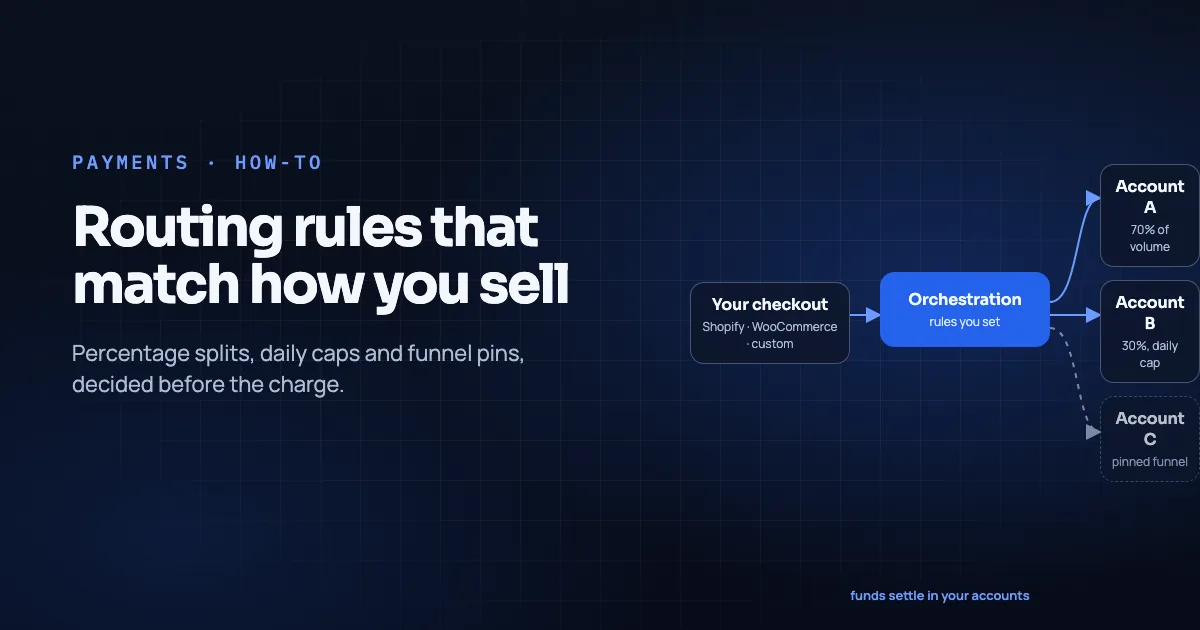
Routing rules only work if they match how you actually sell. Here is how to design percentage splits, daily caps and funnel pins, evaluated before the card is charged.
This is an operating guide for merchants who already hold two or more payment accounts and want rules they can explain to finance. It focuses on the three rule types Temble documents publicly: percentage splits, daily caps, and funnel pins, applied before the charge (Temble homepage, pricing page, retrieved 2026-11-09). It does not invent authorization-rate gains.
Related reading: What Is Payment Orchestration, Soft Declines, Retries, and SCA (Temble does not cross-retry declines), platform guides for Shopify and WooCommerce.
Key Takeaways
- Write pins first, then splits, then caps: evaluation order matters.
- Temble chooses the route before the card is charged. A decline is shown to the shopper and is not retried on another account (Temble homepage, retrieved 2026-11-09).
- Caps that spill to the next account change which bank sees the deposit. Update your ledger habits when caps fire.
- Name every rule after its business reason and date every change so you can tell signal from noise.
In this guide
- What a routing rule is (and is not)
- Before you write a single rule
- Suggested evaluation order
- Rule type A: percentage splits
- Rule type B: daily caps
- Rule type C: funnel (and market) pins
- A hypothetical ruleset (mechanics only)
- Worked scenarios (still hypothetical)
- Governance: who can edit production rules
- Platform notes (without duplicating the long guides)
- Verification checklist
- Common mistakes
- Conclusion
What a routing rule is (and is not)
A routing rule answers: which of my connected payment setups should attempt this order? It is not a discount code, not a fraud model, and not a guarantee the issuer will approve.
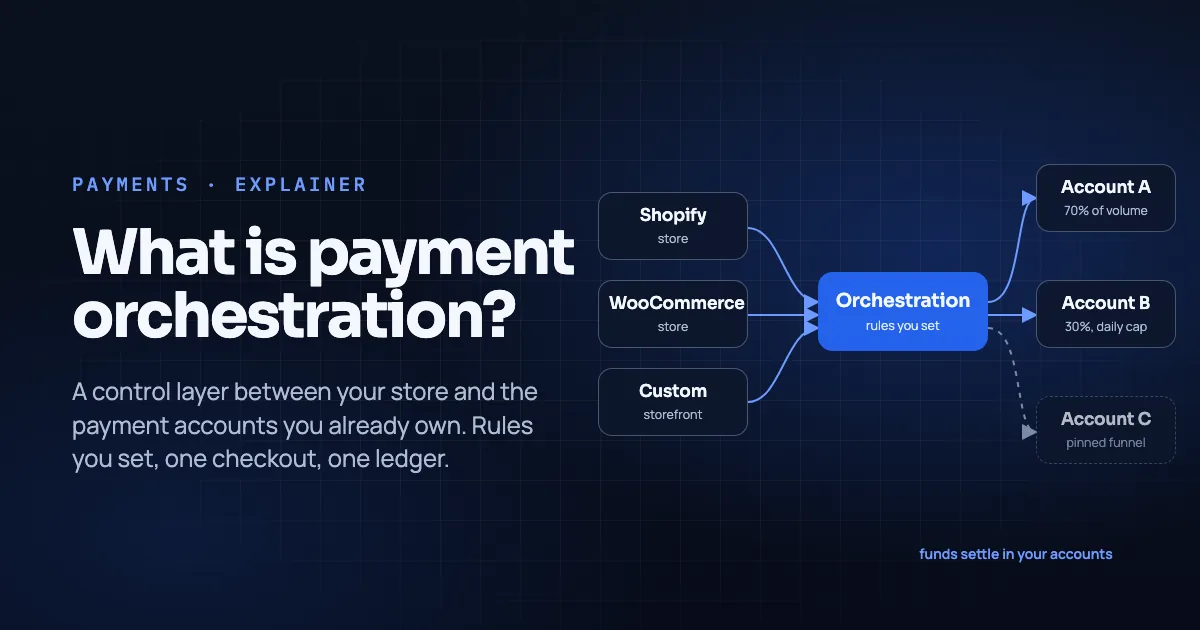
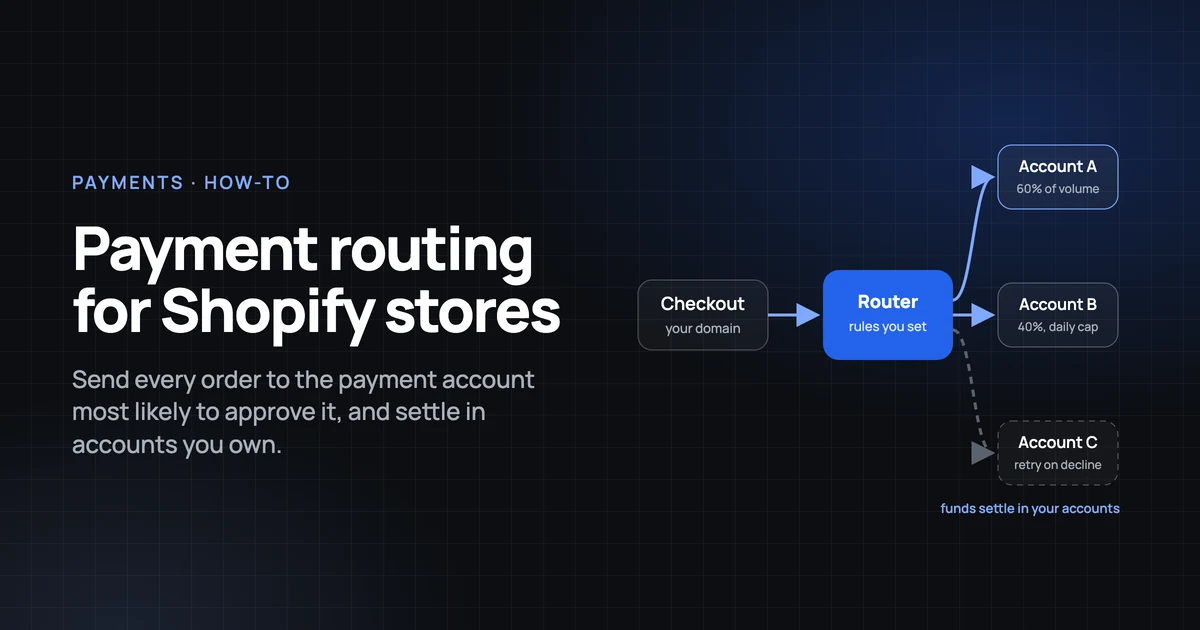
On Temble, the documented rule families are (Temble homepage, retrieved 2026-11-09):
- Percentage split: share eligible volume across setups (e.g. 70% / 30%).
- Daily cap: stop sending new volume to a setup after a money (or volume) limit. Remaining traffic moves to the next setup you chose.
- Funnel pin: send a specific funnel (and, on Temble's homepage copy, a market or launch) to one setup.
All three are decided before the charge. After a decline, Temble does not bounce the attempt elsewhere (Temble homepage).
Before you write a single rule
Gather:
- The list of connected accounts, with countries/currencies each can acquire.
- 30–90 days of attempts per account (auth rate, decline mix, fees).
- The funnels or storefronts you run (main theme checkout, landing-page funnel, subscription SKU, etc.).
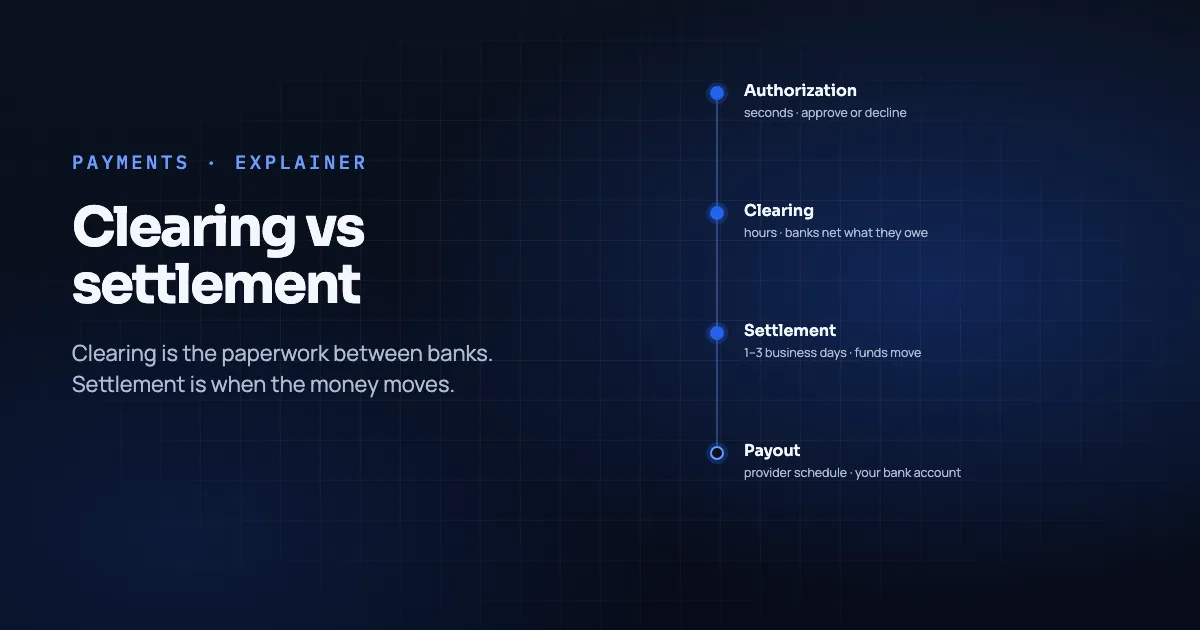
- Payout calendars per account (see clearing vs settlement).
- Who is allowed to edit rules in production.
If you only have one account, stop. Open the second destination first; orchestration without destinations is an empty dashboard (orchestration guide).
Suggested evaluation order
Use a fixed order so two rules never "fight" silently:
- Pins (most specific): this funnel / market / launch → Account X.
- Default split: everything else → percentages across accounts.
- Caps: if the chosen account is over its daily cap → spill to the next account you named.
Document that order in a shared note. Someone will ask why a Berlin order hit Account A at 23:50. You should be able to point to pin → split → cap without archaeology.
Rule type A: percentage splits
Use when: both accounts can handle the traffic, and you want diversification, commercial commitments, or gradual migration.
Write it like this:
- Eligible traffic: e.g. "all non-pinned orders."
- Weights: 70% Account A / 30% Account B.
- Review cadence: monthly against auth rate and fee per order (no vanity targets).
Avoid: splitting before you know each account's decline mix. A 50/50 split that sends EU cards to a US-only acquirer is not diversification; it is self-inflicted soft declines.
Rule type B: daily caps
Use when: an account has a volume ceiling (risk appetite, reserve pressure, contract limit) or you want to protect headroom for a launch.
Temble's product copy: once the cap is reached, payments move to the next setup you chose (Temble homepage).
Write it like this:
- Cap metric: money per day in a single currency, or order count if that matches how your provider limits you.
- Spill target: the explicit next account.
- Timezone: whose midnight? Pick one and write it down.
- Alert: notify ops when spill starts so finance is not surprised by deposits shifting.
Avoid: caps without spill targets, and caps you never monitor. A silent cap that dumps everything onto a secondary account at 16:00 will look like an "auth rate mystery" in the weekly review.
Rule type C: funnel (and market) pins
Use when: a specific acquisition path must stay on one setup. Examples: a TV campaign landing page, a high-risk SKU funnel, a partner co-branded checkout, or a market with local acquiring.
Write it like this:
- Scope: funnel ID / URL path / storefront / market code, whatever your dashboard actually keys on.
- Destination: one account.
- End date: pins for launches should expire; forgotten pins become permanent debt.
Pins beat splits. If a funnel is pinned to A, it should not also be percentage-split to B. The exception is a more specific override you intentionally stacked and documented.
A hypothetical ruleset (mechanics only)
Accounts: A (US), B (EU). Stores: Shopify + one campaign funnel.
- Pin: campaign funnel → A (weekend only; calendar note ends Sunday 23:59 UTC).
- Pin: EUR presentment or EU shipping country → B.
- Split: all other → 70% A / 30% B.
- Cap: B at €25,000 / day → spill to A.
Order: €90 to Lyon, Tuesday, main store. Rule 2 → B. B under cap → B attempts. If B declines, the shopper sees the decline: no Temble retry on A (Temble homepage; retries playbook).
The example shows mechanics only. It does not predict approval rates.
Worked scenarios (still hypothetical)
Migration. You are moving from 100% Account A to a mix with Account B. Pin nothing at first. Split 90/10 for one week, watch decline mix and support volume, then 70/30. Date every change. Do not call the week a "success" without the baseline from before the change.
Risk isolation. A supplements funnel carries higher dispute scrutiny. Pin that funnel to the account underwritten for it. Keep the main fashion catalog on the lower-risk account. Same brand, two setups, one ledger (one ledger).
Launch protection. Pin a TV-driven landing page to Account A with headroom. Put a daily cap on A for organic traffic if you must protect authorization capacity for the launch window. Do this only if your provider realities make it necessary. Caps are a tool, not a flex.
EU local acquiring. Pin EU shipping or EUR presentment to the EU account. Split the remainder. Cap the EU account if it has a ceiling, and spill back to the US account knowingly. Expect cross-border fee effects on those spilled orders.
In every scenario, remember Temble will not rescue a decline by trying the other account (Temble homepage; retries playbook). First-attempt placement is the lever you actually have.
Governance: who can edit production rules
Treat routing rules like production config:
- Two people minimum who understand pins vs splits vs caps.
- Staging or a low-stakes store for experiments when you can.
- A change log: date, author, rule diff, reason.
- A rollback plan: previous weights kept in the note, not in someone's head.
Agencies implementing Temble for clients should put this in the handoff. See the partner program if you sell or implement the stack.
Platform notes (without duplicating the long guides)
- Shopify: one primary credit-card provider slot in practice; routing rules usually live inside whatever fills that slot. Details: Shopify routing guide.
- WooCommerce: you can enable multiple gateways and reorder them for the shopper (WooCommerce Payments settings, retrieved 2026-11-09). Customer choice is not the same as automatic acquirer routing. For true multi-account rules behind one card experience, use a routing layer: WooCommerce routing guide.
Verification checklist
After go-live:
- One test order per pin path.
- One non-pinned order lands on the split as expected (check ledger provider field).
- A cap test in staging (or a low cap in production off-hours) spills correctly.
- Decline path shows the shopper a clear failure (no silent second account).
- Finance can match two payouts to ledger rows (one ledger).
Common mistakes
- Writing splits before pins.
- Caps with no owner and no alert.
- Changing weights daily without dating the change.
- Expecting rules to replace SCA-aware retry policy (retries playbook).
- Forgetting that spill destinations inherit that account's fees and payout timing (clearing vs settlement).
Conclusion
Good routing rules are boring: specific pins, simple splits, honest caps, clear ownership. Temble evaluates them before the charge and will not invent a second attempt after a decline.
When you want to see splits, caps and pins on a connected store, book a 30-minute walkthrough. Or skim pricing for what the weekly platform fee includes.
About the author. Mattieux Rinot is an SEO Expert at Temble. Temble is a payment orchestration layer that routes payments across a merchant's own accounts and never holds the funds. Mattieux has five years of experience across CRM, customer success and payment processing.
Corrections. Send errors via the contact page; we add a dated update note.
Sources
- Temble homepage and pricing page (rule types, pre-charge routing, decline behavior), retrieved 2026-11-09
- WooCommerce: Configuring settings (Payments), retrieved 2026-11-09
- What Is Payment Orchestration, Soft Declines, Retries, and SCA, Payment Routing on Shopify, Payment Routing on WooCommerce, One Ledger, Clearing vs Settlement