
A processing rate is not a software plan. "2.9%" on a comparison tab is an indicative price for a risk band. It is not a toggle that unlocks better checkout, more routing rules, or a prettier thank-you page.
This explainer is for founders who received a higher quote than a competitor's blog showed. It is also for founders who assumed they would pay more to "turn on" pins and the ledger.
It uses Temble's public pricing as of the pages retrieved on 2026-11-10. A light amount of network context explains why dispute and fraud exposure has a cost. The explainer does not invent a rate-match guarantee, and it does not replace the written rate you receive at onboarding.
Key Takeaways
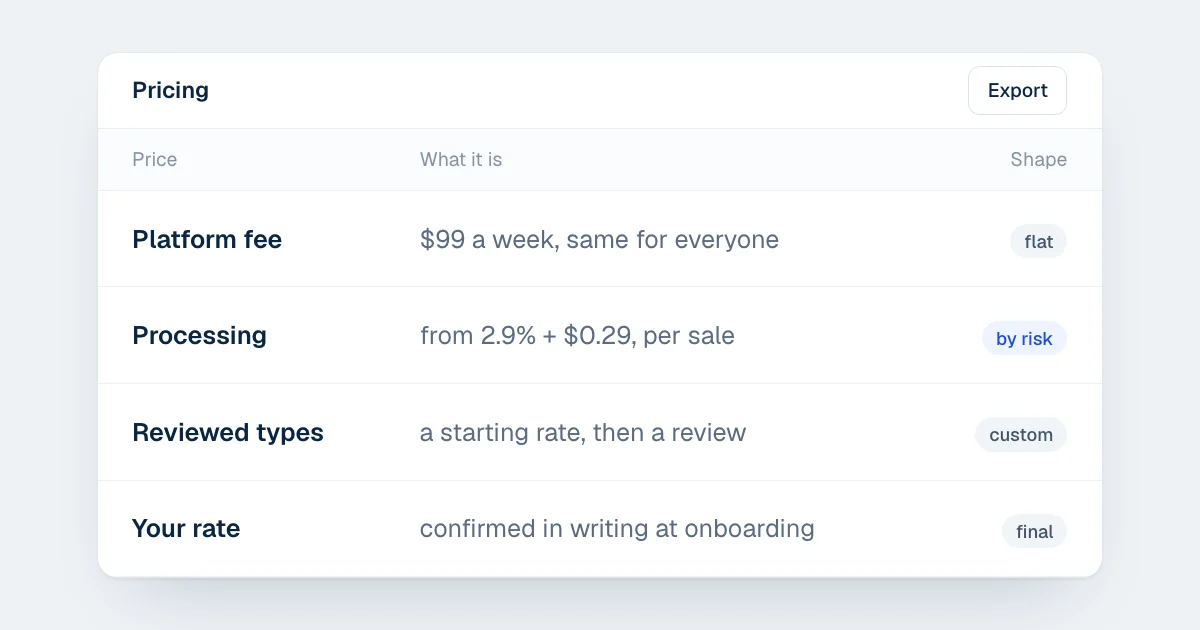
- Temble charges a flat $99 per week platform fee, whatever the volume, and $0 setup. Processing is billed per successful transaction and follows the business (pricing page, retrieved 2026-11-10).
- Everyone gets the same platform in that weekly fee: hosted checkout, routing, ledger, catalog, offers and the API. There are no seat packs and no checkout tier (pricing page).
- Indicative processing starts at 2.9% + $0.29 for lower-risk commerce and rises with chargeback exposure, regulatory constraints and setup complexity. Your rate is confirmed in writing during onboarding (pricing page).
- Card networks also price residual fraud and dispute risk. Visa's Acquirer Monitoring Program is one public example of thresholds that can create cost in the ecosystem (see below). That is context, not Temble's fee table.
- Merchants processing above $500,000 a month through Temble move to a custom processing rate below the calculator's indicative pricing, with a named contact. The weekly fee does not change (pricing page, retrieved 2026-11-10).
In this guide
- Two prices, two jobs
- What the weekly fee includes (so you don't buy pins twice)
- How indicative processing bands are presented
- Why risk shows up in the rate at all
- How to read a quote without getting surprised later
- Frequently asked questions
- Conclusion
Two prices, two jobs
| Charge | What it is for | What it does not do |
|---|---|---|
| Platform fee: $99 / week | The software layer: checkout on your subdomain, routing rules, ledger, catalog, offers, API and webhooks | Underwrite your vertical or settle your funds |
| Processing: % + fixed, per successful payment | The cost of taking the payment on the connected path, priced for the risk of your model | Unlock "pro" routing or a second dashboard |
Temble's FAQ states this directly: the calculator shows an indicative rate for a business type. The platform fee is the same for everyone, $99 a week (pricing page, retrieved 2026-11-10). Processing is on top. The homepage describes the fee Temble takes as an application fee on the payment. There is no Temble balance for your revenue, and funds settle in the accounts you own (Temble homepage, retrieved 2026-11-10).
If you are comparing vendors, ask which number is the platform subscription and which is processing. Also ask whether "2.9%" assumes a vertical you do not actually run.
What the weekly fee includes (so you don't buy pins twice)
From the pricing page's "Included with the weekly fee" section, retrieved 2026-11-10:
- Hosted checkout: your own subdomain; Shopify, WooCommerce and custom; the design you publish with the funnel.
- Routing: percentage splits, daily caps, a funnel pinned to one account.
- Ledger: every channel in one list, the shop named on each payment, refunds and exports.
- Catalog: products synced from the store, products you create, payment links.
- Offers: discount codes, one-click upsells at checkout, shipping rules you define.
- Developers: signed store API, verifiable webhooks, card data that stays with the processor.
"What you turn on in the dashboard is what the store gets." You do not pay a higher processing rate to access those modules. You may pay a higher processing rate because the business is harder to monitor. That distinction is the whole point of this article.
Related reading: hosted checkout, routing rules, the ledger, offers and upsells.
How indicative processing bands are presented
Temble's public copy presents the bands this way (pricing page, retrieved 2026-11-10):
- Lower-risk physical goods with predictable delivery and few disputes start at 2.9% + $0.29.
- Complex models (recurring billing, instant digital delivery, elevated chargeback exposure) sit higher.
- Restricted or emerging verticals are priced from a starting rate, subject to review and to the payment accounts available for them.
Indicative calculator rows visible on that page on 2026-11-10 included, among others:
| Business type (calculator label) | Indicative processing |
|---|---|
| Classic e-commerce; SaaS & software | 2.9% |
| Premium & high-ticket | 3.5% |
| Gaming & digital goods; Subscription commerce | from 5% |
| Supplements & nutraceuticals; Higher-risk e-commerce; Gummy | from 6% |
| Pill | from 6.5% |
| Medical Device | from 7% |
| Nicotine & vape; Crypto & web3; Peptides & research compounds | from 8% |
| Adult; Casino & gambling | from 10% |
Treat the table as a snapshot of the public calculator, not as your contract. If your business type is not listed, use the contact path. Temble says it will confirm setup and pricing (pricing page). "Subject to review" means additional checks and compatible accounts, not automatic approval. See When Processors Restrict Your Vertical and Why Processors Treat Subscriptions as Higher Risk.
Volume. Above $500k a month processed through Temble, processing moves to a custom rate below the calculator's indicative pricing, with a named contact. The weekly fee stays $99 (pricing page, retrieved 2026-11-10). There is no public "we will always beat vendor X" promise on that page.
Why risk shows up in the rate at all
Two layers sit underneath a merchant quote:
1. Your model and history. Delivery promises, dispute and refund patterns, regulated catalogs, trial mechanics, cross-border mix. These are things you can actually operate.
2. Network monitoring. Card networks run programs that identify acquirers and merchants with elevated fraud and dispute ratios. Visa's Acquirer Monitoring Program (VAMP) uses a combined ratio of fraud reports and disputes to settled card-not-present transactions. Visa's fact sheet states the following (Visa VAMP fact sheet, program updates described in that document):
- The Excessive merchant threshold in AP, Canada, the EU and the U.S. goes down to ≥150 bps (1.5%) from 1 April 2026.
- A minimum monthly count of fraud and disputes applies.
- Identified entities must implement risk-mitigation controls.
That network context is why "a few extra chargebacks" is not only a customer-service problem. The same chargebacks can become program identification and cost at the acquirer, which processors eventually price into merchant rates. That context is not Temble's fee schedule, and Temble is not described here as calculating your VAMP ratio. For the briefing, see Visa VAMP in 2026.
How to read a quote without getting surprised later
- Ask for the platform fee and the processing rate separately, in writing.
- Confirm the vertical and billing model the quote assumed (classic retail vs subscription vs a reviewed category).
- Ask which connected accounts are compatible. Temble's processing still settles to accounts in your name (Temble homepage; integrations directory, retrieved 2026-11-10).
- Check what is included versus add-on at the other vendor (seats, routing rules, wallet fees).
- Ignore homepage marketing figures (including any "volume processed" headline) as a rate input. Your letter is the source.
Frequently asked questions
Why isn't there a single processing rate?
Because processing risk is not the same for every business. Temble's own FAQ uses that wording. It says fees start at 2.9% + $0.29 for lower-risk commerce and rise with chargeback exposure, regulatory constraints and setup complexity (pricing page, retrieved 2026-11-10).
If I only need hosted checkout, can I skip routing and pay less per week?
The public weekly fee is one price for the platform, not a menu of checkout tiers (pricing page). You do not have to use every module.
Does a higher rate mean Temble holds more of my money?
No. Settlement remains in your connected accounts; Temble's fee is taken as an application fee; there is no Temble balance (Temble homepage, retrieved 2026-11-10).
Are the calculator percentages plus the $0.29?
The page presents processing from 2.9% + $0.29 per successful transaction for the lower-risk starting point, and shows category percentages in the calculator. During onboarding, confirm whether the fixed component applies to your written rate. Do not assume this article restates every band with the same fixed fee. It repeats only what the starting line says.
Conclusion
Shop processing the way you shop insurance, not the way you shop a SaaS feature matrix. The $99 weekly fee is the product: checkout, routing, ledger, catalog, offers, API. The percentage is a risk price, confirmed in writing, sometimes after review, and sometimes only if a compatible account exists.
If a quote surprised you, match the vertical and the included modules before you assume the other number was "the same 2.9%." Then read the letter, not the calculator screenshot.
To walk through the current calculator against your model, get your rate or book a 30-minute walkthrough.
About the author. Mattieux Rinot is an SEO Expert at Temble. Temble is a payment orchestration layer that routes payments across a merchant's own accounts and never holds the funds. Mattieux has five years of experience across CRM, customer success and payment processing.
Corrections. Errors go to the contact page; we fix them with a dated update note.
Sources
- pricing page (platform fee, inclusions, indicative bands, onboarding confirmation, $500k custom rate, subject to review), retrieved 2026-11-10
- Temble homepage (application fee, no Temble balance), retrieved 2026-11-10
- Visa, Acquirer Monitoring Program fact sheet (VAMP ratio; footnote on Excessive merchant threshold ≥150 bps in AP, Canada, EU and U.S. on 1 April 2026)
- Visa VAMP in 2026
- When Stripe or Shopify Payments Won't Support Your Vertical