
A subscription can be a clean product with happy customers and still look like elevated risk to a processor. The reason is mostly timing. You often capture today for service that continues or, on an annual plan, for service that has barely started. Meanwhile, the customer can still dispute or cancel later.
This article is about underwriting and cash-flow, not about how to retry a soft decline. For dunning and SCA mechanics, use Soft Declines, Retries, and SCA. For rate bands, see Processing Fees Follow Risk, Not Features.
Temble does not document a "Temble Billing" product on the public pricing or integrations pages retrieved for this article. Do not read the paragraphs below as a subscription-platform pitch.
Key Takeaways
- Shopify Payments lists extended billing cycles (for example annual subscriptions) among factors that can lead to a reserve. The reason it gives is that customers may discontinue or change their mind after paying (Shopify Help: Reserves, retrieved 2026-11-10).
- The same help center asks merchants to make recurring terms clear and cancellation easy, and it reviews pre-selections that trick customers into subscriptions (Shopify Help: Acceptable business practices, retrieved 2026-11-10).
- Stripe prohibits negative-option marketing and reduced-price trials with unclear or hidden pricing (Stripe: Prohibited and Restricted Businesses, updated 2026-09-22).
- Temble's pricing calculator lists Subscription commerce as its own indicative band, from 5% in the calculator retrieved 2026-11-10. That is because recurring billing is treated as a more complex, higher-monitoring model (pricing page).
- No authorization or churn percentages are claimed here.
In this guide
- The dispute-window problem, in plain language
- What official policies ask you to do
- Why "normal quality" is not enough
- How Temble's public pricing treats the model
- Operating habits before you scale annual prepay
- Frequently asked questions
- Conclusion
The dispute-window problem, in plain language
On a one-off T-shirt, the customer usually has the goods quickly. On a subscription:
- The first charge may cover a trial, a first month, or a full year.
- Service quality is judged over time. A cardholder who is unhappy in month four may still have paid in month one, especially on annual prepay.
- Cancellation may be hard to find, or a renewal may not have been obvious. That is exactly the fact pattern issuers see in "I didn't know I'd be billed" disputes.
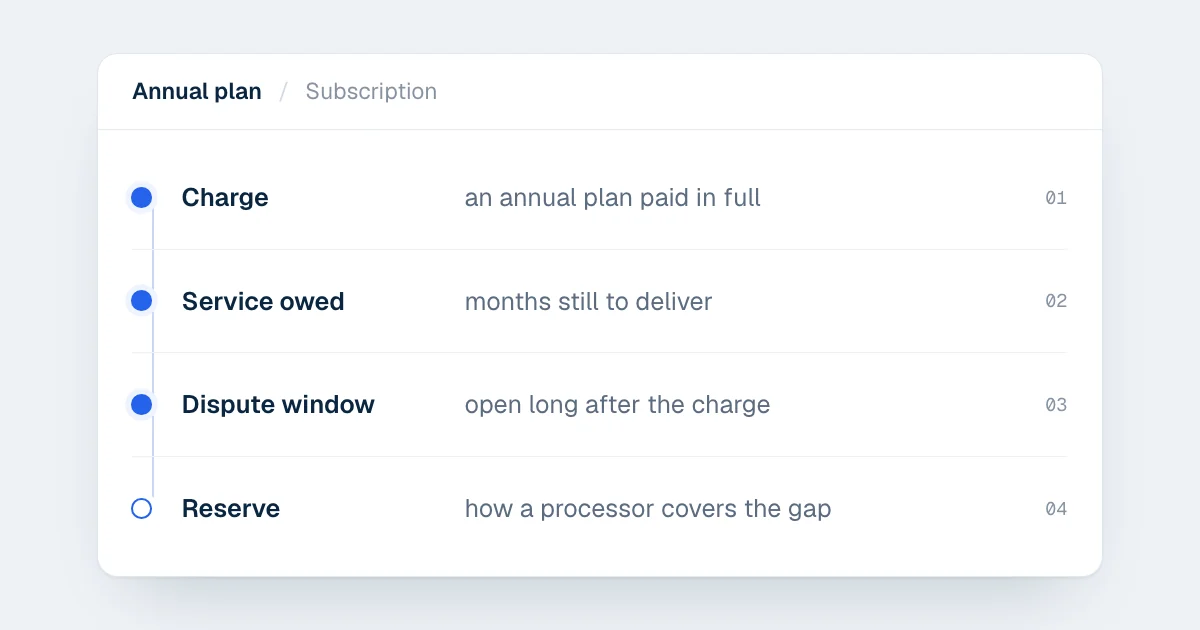
Shopify's reserve documentation says businesses with extended billing cycles are "particularly vulnerable to disputes from customers discontinuing services or altering purchase decisions" (Shopify Help: Reserves, retrieved 2026-11-10). It gives annual subscriptions as the example. That is the underwriter's model: residual refund and chargeback exposure lasts longer than the payout you already spent on ads and inventory.
None of that requires the product to be a scam. It requires cash-flow discipline: you may not be able to treat annual prepay as fully "earned cash" the day it settles.
What official policies ask you to do
Shopify Payments. Risk reviews include transparency of recurring billing terms and ease of cancellation. That includes businesses that operate with longer billing cycles, such as annual subscriptions. Reviews also cover pre-selections or designs that trick customers into enrolling without a clear understanding (Shopify Help: Acceptable business practices, retrieved 2026-11-10). Best-practice wording on the same page: make recurring terms clear, make canceling easy, and keep communication transparent and honest. The review criteria also look at clear communication when something changes.
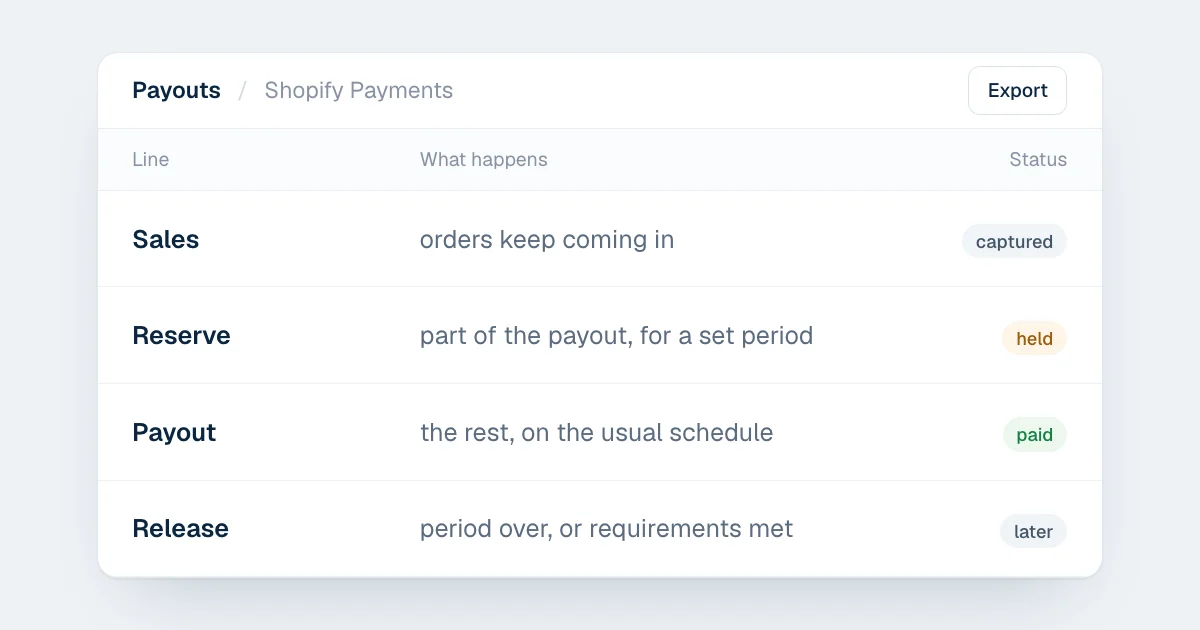
A reserve, if one is placed, is a temporary hold on a portion (sometimes all) of Shopify Payments transactions for a period. Reserves generally do not, by themselves, stop you accepting payments unless Shopify says otherwise (Shopify Help: Reserves). How to see and appeal a reserve belongs in the reserves explainer: When Shopify Payments Puts a Reserve on Your Payouts.
Stripe. Among prohibited unfair practices: negative-option marketing, negative-option membership clubs, and reduced-price trials with unclear or hidden pricing; also high-pressure upselling and deceptive testimonials (Stripe, updated 2026-09-22). Suppose your "subscription growth" motion is a pre-ticked box or a trial that becomes a surprise annual plan. You are then not only annoying customers: you may be outside what a mainstream processor will support. Offers and upsells done clearly are a different topic: One-Click Upsells at Checkout.
Why "normal quality" is not enough
Processors also watch operational signals that have nothing to do with fabric quality or software uptime:
- Chargeback rates and trends, plus refund and dispute-resolution practices (Shopify Help: Acceptable business practices).
- Rapid volume increases (same page). A viral annual-plan campaign can look like a risk spike, not only a win.
- Support responsiveness when people try to cancel.
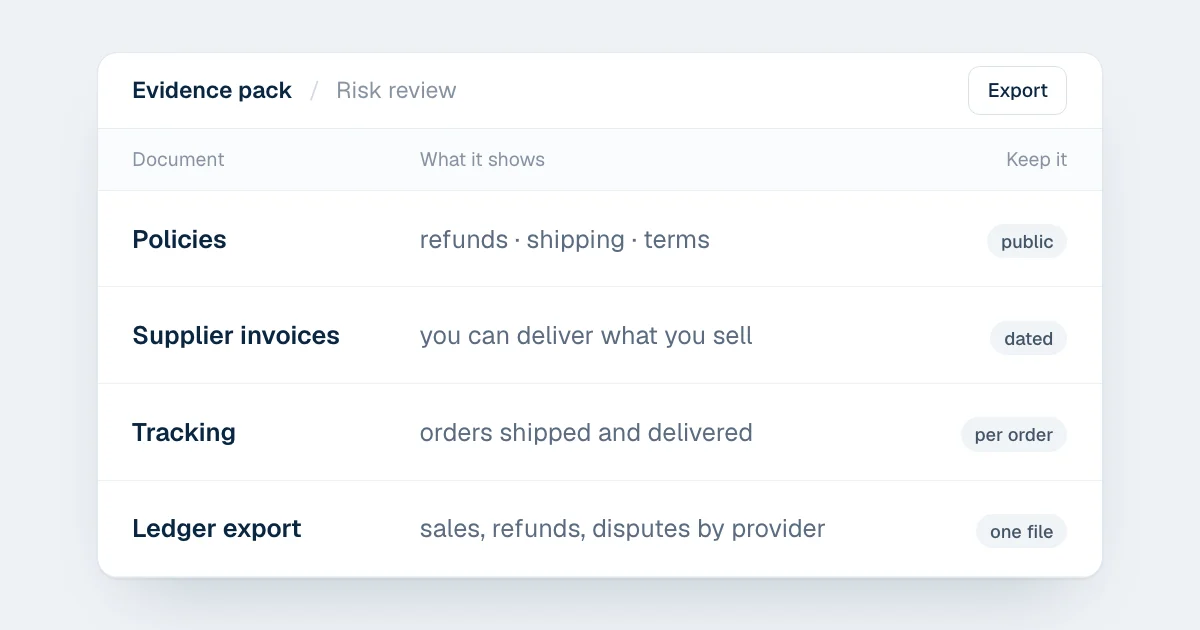
A trial-heavy funnel that performs in ads but generates "I was still charged" tickets will surface in those signals. Fix the terms and the cancel path before you scale spend. Keep an evidence folder of policies and billing emails for the day a review starts (evidence pack).
How Temble's public pricing treats the model
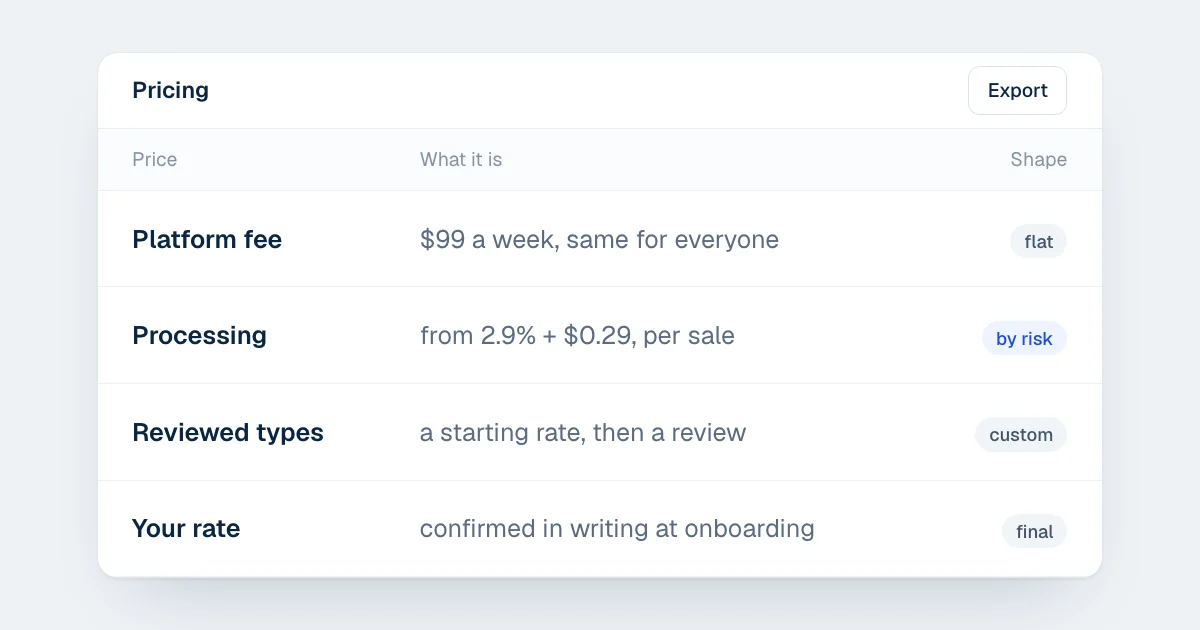
Temble states that processing fees follow the business. It says recurring billing, instant digital delivery or elevated chargeback exposure need more monitoring, so the indicative rate is higher (pricing page, retrieved 2026-11-10). In the calculator retrieved the same day, Subscription commerce appears as its own category, from 5%, distinct from classic e-commerce at 2.9%. Rates are indicative; the written rate is confirmed at onboarding based on model, volume, history and risk.
The weekly platform fee ($99, no setup fee) does not change with the vertical. Checkout, routing, ledger, catalog, offers and the API stay in that fee (pricing page). You do not "unlock" routing by paying a higher processing rate. The rate is about risk, not features. The detail is in the risk-based pricing explainer.
Again: there is no public "Temble Subscriptions" billing product claimed here. You may already bill recurring on Shopify, WooCommerce or your own stack. Temble can still be the checkout and routing layer in front of connected accounts, with one ledger across one-off and recurring channels. Confirm the exact recurring integration in onboarding rather than assuming it from the homepage dashboard chrome.
Operating habits before you scale annual prepay
- Write the offer in one screen: price now, price at renewal, renewal date, how to cancel, what happens to unused time.
- Make cancellation a first-class path (account page or a clearly monitored email), not a scavenger hunt.
- Be careful with annual prepay until refund policy and cash reserves can absorb early cancellations and any processor reserve.
- Separate trial funnels from the core paid base if they carry different risk. One option is a pin to an account underwritten for that funnel, if you have one (routing rules; high-risk verticals).
- Reconcile refunds by reason (product vs "did not mean to subscribe") so finance and support argue from the same export.
- Do not invent dunning policy in a sales deck. Retry behavior is product- and regulator-specific. Temble does not retry a declined card on another account (Temble homepage, retrieved 2026-11-10). Use the retries playbook for the mechanics conversation with your processor.
Frequently asked questions
Why is my indicative rate higher than 2.9% if I sell a simple subscription box?
Because the billing model is part of the risk, not only the SKU. Temble's public copy treats recurring billing as a more monitored setup (pricing page, retrieved 2026-11-10). Your written rate still depends on onboarding.
Will switching processors remove a reserve on annual plans?
A new account has its own underwriting. It does not automatically release funds held at the previous provider, and it will ask similar questions about terms and dispute history.
Does Temble hold the prepay until the year is delivered?
No. Temble does not hold merchant funds and has no Temble balance for your revenue (Temble homepage, retrieved 2026-11-10). Settlement and any reserve sit at the connected processor.
Conclusion
Processors price and sometimes reserve subscription businesses because cash arrives before the obligation is fully discharged, and because unclear trials create disputes. Clear terms, easy cancellation and honest prepay accounting are the controls you own. A higher indicative processing rate is a monitoring cost, not a feature unlock.
Fix the offer page first. Then talk to whoever underwrites the account. That includes Temble's risk-based onboarding if you use it as the orchestration layer.
To review how subscription volume would sit on connected accounts and the ledger, book a 30-minute walkthrough.
About the author. Mattieux Rinot is an SEO Expert at Temble. Temble is a payment orchestration layer that routes payments across a merchant's own accounts and never holds the funds. Mattieux has five years of experience across CRM, customer success and payment processing.
Corrections. Errors go to the contact page; we fix them with a dated update note.
Sources
- Shopify Help: Overview of reserves in Shopify Payments (extended billing cycles), retrieved 2026-11-10
- Shopify Help: Acceptable business practices and risk evaluation (recurring terms, cancellation, pre-selections), retrieved 2026-11-10
- Stripe, Prohibited and Restricted Businesses (negative-option marketing; unclear trials), updated 2026-09-22
- pricing page (Subscription commerce band; risk-based fees), retrieved 2026-11-10
- Temble homepage (custody, decline behavior), retrieved 2026-11-10
- Soft Declines, Retries, and SCA
- Processing Fees Follow Risk, Not Features