
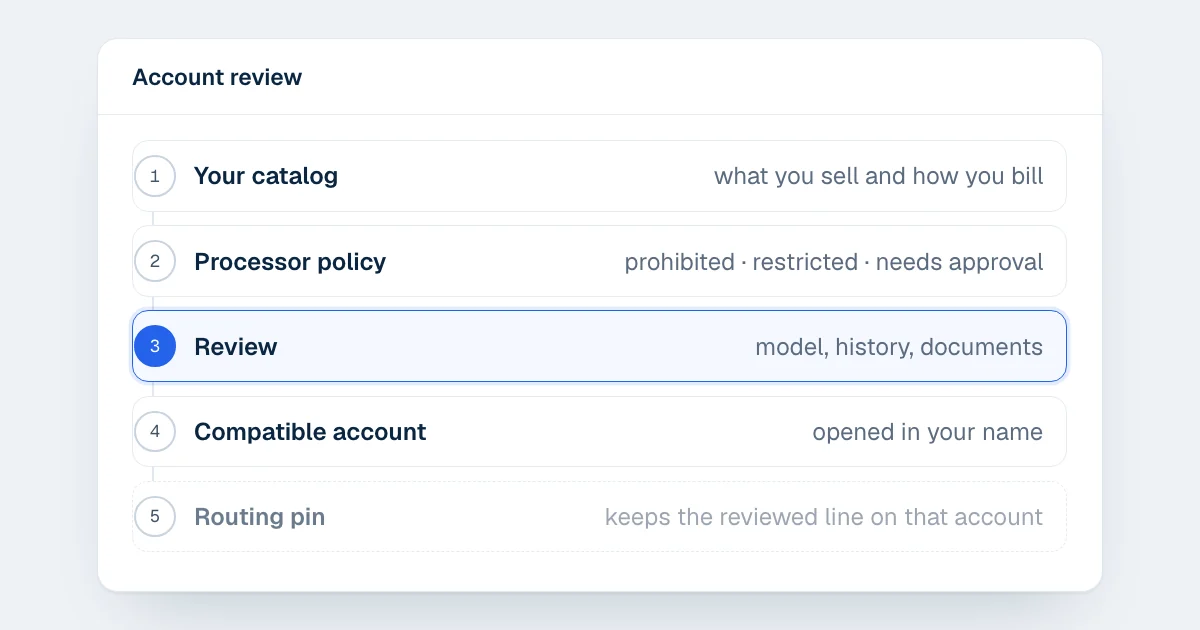
A processor restriction is not a comment on whether your product is "real." It is an underwriting decision. It weighs card-network rules, banking partners, dispute history in the category, and how you sell (trials, pre-selected subscriptions, claims on the page).
This guide is for founders whose catalog sits near a review line: supplements, subscriptions, delayed fulfillment, gambling-adjacent offers. If that is you, you need to read official policy pages before you assume a second account will "just work." This guide is not a promise that Temble, Stripe or Shopify Payments will approve a restricted category.
For how rates follow risk rather than feature tiers, see Why Your Processing Rate Isn't a Checkout Feature. For whether a second account is even justified, see Should You Run Multiple Payment Providers?.
Key Takeaways
- Stripe distinguishes prohibited businesses (must not use Stripe) from restricted ones (extra due diligence; approval is not guaranteed and can be modified or revoked) (Stripe: Prohibited and Restricted Businesses, updated 2026-09-22).
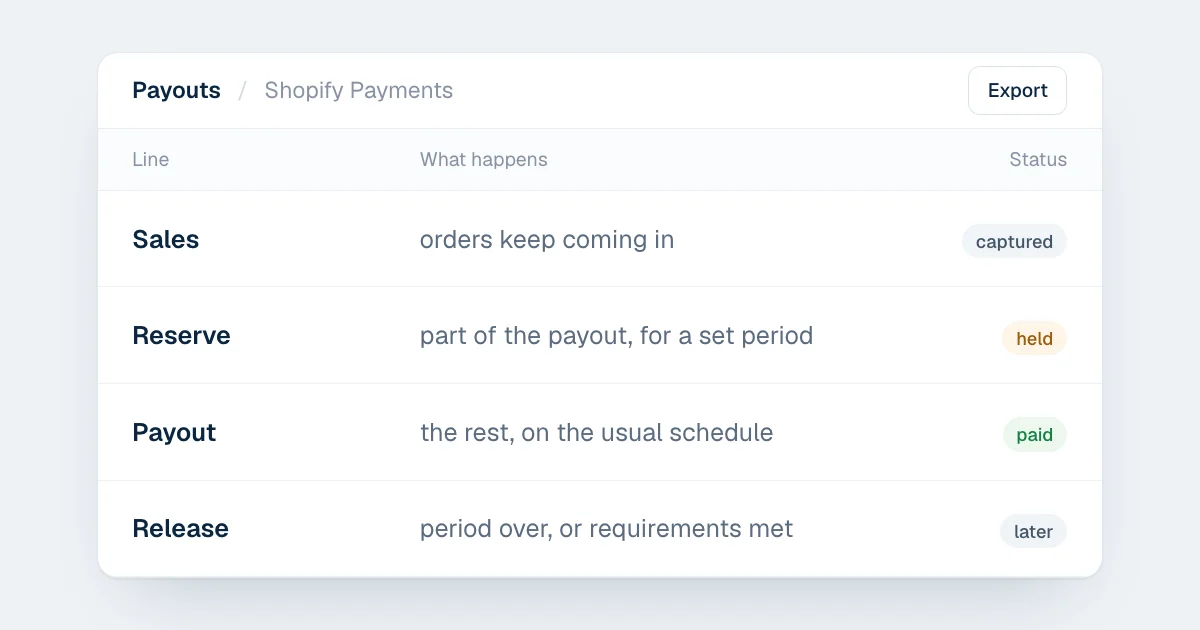
- Shopify Payments evaluates risk at application and continuously; elevated risk can mean payout delays, reserves, holds or deactivation. If Payments is declined or deactivated, Shopify's own docs say you can activate a third-party payment provider to keep processing (Shopify Help: Acceptable business practices, retrieved 2026-11-10).
- Temble's public pricing follows risk, not a feature gate. Some categories are custom and subject to review, and to the payment accounts available for them. Pricing is confirmed in writing at onboarding (pricing page, retrieved 2026-11-10).
- Routing pins can keep a higher-risk funnel on the account that was underwritten for it (how to write routing rules). They do not create underwriting that does not exist.
- Nobody here promises approval for a restricted or prohibited category.
In this guide
- Why verticals get extra scrutiny
- What official policy pages actually say
- What "subject to review" means on Temble pricing
- Routing helps isolate risk. It does not invent a MID.
- An operating sequence when a processor says no
- Frequently asked questions
- Conclusion
Why verticals get extra scrutiny
Underwriters look at more than SKU names. Typical drivers, in plain language:
- Dispute and refund patterns that are structurally more common in a model (subscriptions, delayed delivery, ingestible products, instant digital goods).
- Marketing and consent. Hidden trials, negative-option billing and high-pressure upsells are not "growth tactics" to a processor. They are policy problems. Stripe lists negative-option marketing and reduced-price trials with unclear or hidden pricing among prohibited unfair practices (Stripe, updated 2026-09-22). The same section flags high-pressure upselling and deceptive testimonials. Shopify Payments reviews transparency of recurring terms, ease of cancellation, and pre-selections that trick customers into subscriptions (Shopify Help, retrieved 2026-11-10). See One-Click Upsells at Checkout.
- Fulfillment gap. The longer the time between capture and delivery, the longer the dispute window can matter. Shopify lists extended delivery timelines (events, custom orders, pre-orders) among reserve factors (Shopify Help: Reserves, retrieved 2026-11-10). For detail, see Pre-Orders and Custom Orders.
- Legal and network constraints. Gambling, certain financial services, sanctions exposure and unsafe product claims can be prohibited outright, not merely "priced higher."
A clean product can still sit in a reviewed band because the model is harder to monitor. That is commercial logic, not a moral verdict.
What official policy pages actually say
Stripe: prohibited versus restricted. Prohibited categories must not use Stripe. The list is representative, not exhaustive (Stripe, updated 2026-09-22). Among many others, it includes gambling and games of chance or skill with a monetary or material prize. It also includes pseudo-pharmaceuticals or nutraceuticals that are not safe or that make harmful claims, and the unfair-practices group above (same page).
Restricted businesses require additional due diligence. Stripe may be unable to grant approval. If it does, approval is specific to each service and may be modified or revoked under the Services Agreement (same page).
Read the current list for your entity and countries. Do not treat a blog summary as the policy.
Shopify Payments: continuous evaluation. Eligibility is assessed at application and monitored throughout use. Review areas include product accuracy, shipping versus promises and recurring-term transparency. They also include chargeback rates and trends, refund and dispute-resolution practices, and rapid volume increases (Shopify Help: Acceptable business practices, retrieved 2026-11-10).
Actions for elevated risk include custom payout schedules, reserves, holds and documentation requests. In severe cases, they include payout suspension or deactivation of charges. For a custom payout schedule, Shopify cites 5 to 20 business days as a possible range (same page).
If the account is declined or deactivated, Shopify says you receive an email with next steps and may appeal. It adds that you can also activate a third-party payment provider to continue processing (same page). That is an official option, not a guarantee the third-party provider will accept the same catalog.
What "subject to review" means on Temble pricing
Temble's public pricing page states that processing fees follow the business. Lower-risk models pay less, and complex or higher-risk models pay more. Some categories are custom and subject to review (pricing page, retrieved 2026-11-10).
The same page, retrieved for this article, shows indicative starting rates by business type. Examples include:
- Classic e-commerce and SaaS at 2.9%.
- Premium and high-ticket at 3.5%.
- Subscription commerce and gaming & digital goods from 5%.
- Supplements & nutraceuticals and higher-risk e-commerce from 6%.
- Peptides & research compounds, nicotine & vape, and crypto & web3 from 8%.
- Adult and casino & gambling from 10%.
The calculator names other bands too. Rates are indicative. Your pricing is confirmed in writing during onboarding, based on business model, volume and risk profile.
The FAQ is explicit: some higher-risk or restricted businesses are accepted after review. Categories marked subject to review or subject to approval need additional checks and compatible payment accounts. Their pricing starts at the rate shown and can vary (pricing page, retrieved 2026-11-10).
Two consequences follow:
- A calculator row is not an approval. Listing "supplements" or "casino" as a pricing band has a narrow meaning. Temble will talk about that model and quote a rate if, and only if, a compatible connected account exists and the review passes.
- Temble is not the acquirer. You connect payment accounts in your name. Methods and acceptance follow what those accounts enable. As of the integrations directory retrieved 2026-11-10, processors listed Live as routing destinations are Stripe, Finix and Nuvei. Checkout.com is listed as coming soon (integrations directory). If Stripe's prohibited list blocks the vertical, connecting "Temble" does not override Stripe's policy on that account.
Temble never holds merchant funds; settlement stays in the connected accounts (Temble homepage, retrieved 2026-11-10). A reserve or closure at a processor still lives there.
Routing helps isolate risk. It does not invent a MID.
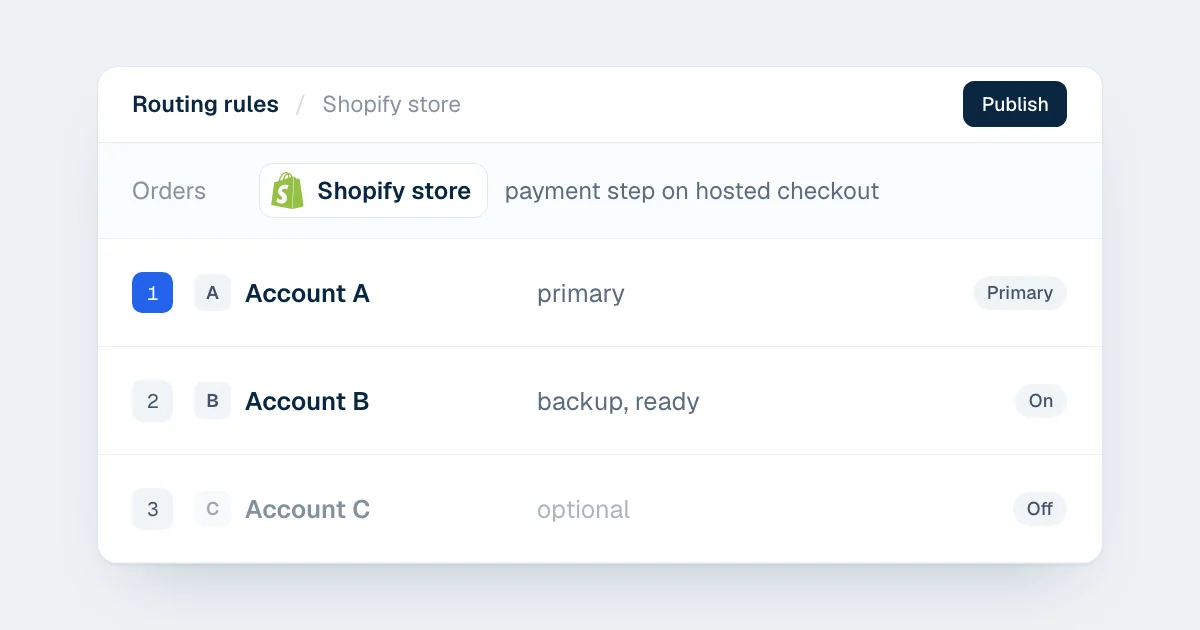
You may already hold two accounts, for example a lower-risk catalog account and a second account underwritten for a reviewed funnel. If so, a funnel pin can send the reviewed offer to the account that was boarded for it (Temble homepage; routing rules). It can leave the core catalog on the other. Daily caps can protect a volume or risk limit, then spill to the next account you named.
What routing will not do, on Temble's published behavior:
- Approve a vertical your connected processors prohibit.
- Retry a declined card on the "other" account (Temble homepage, retrieved 2026-11-10).
- Hold or release funds on your behalf. There is no Temble balance.
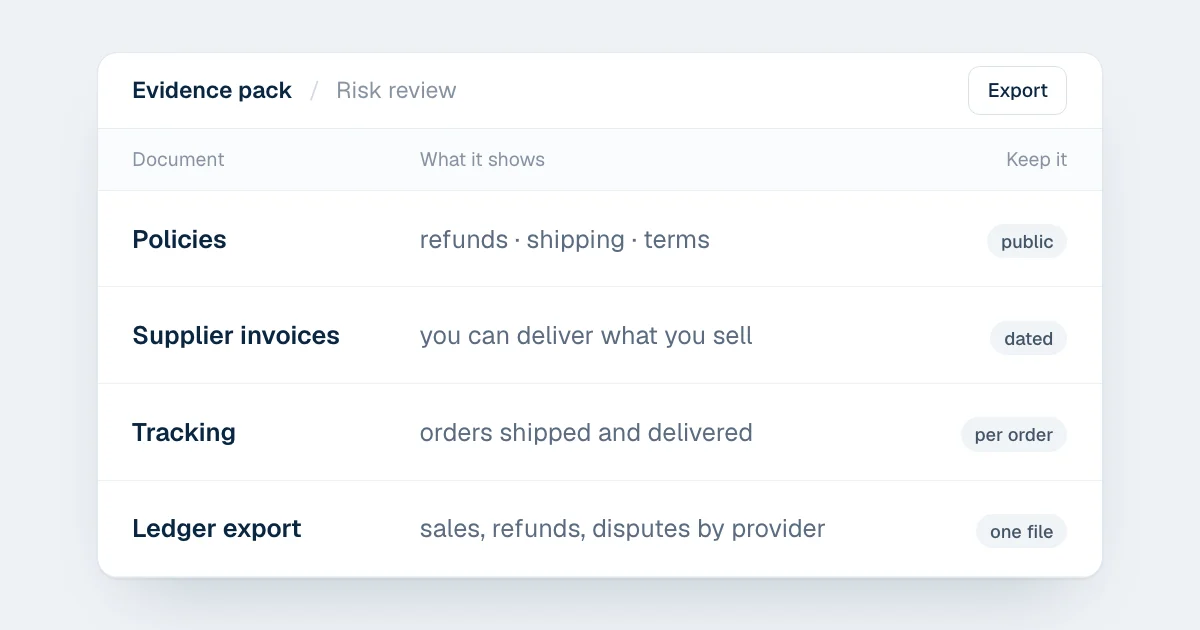
Build the second account first, with honest descriptors and a matching website. Then write the pin. For the evidence you will be asked for, see The Evidence Pack Your Processor Will Ask For.
An operating sequence when a processor says no
- Read the letter and the policy page, not only the support chat summary. Prohibited, restricted, reserve, hold and deactivation are different states.
- Stop mixing catalogs on the same account if one line is the problem. An example is a trial funnel sharing a MID with in-stock apparel.
- Do not scrape together a new processor the same week and route live traffic before underwriting finishes.
- Ask the next provider the vertical question up front, with the same claims, billing terms and fulfillment timelines you actually use.
- Only then connect a qualified account to checkout. If you have more than one destination, write pins and caps you can explain to finance.
Frequently asked questions
If Temble lists my category in the pricing calculator, am I approved?
No. The calculator is indicative. Acceptance and the written rate depend on onboarding review and on compatible payment accounts (pricing page, retrieved 2026-11-10).
Can I use a "friendly" product description to get a lower-risk rate?
No. Misrepresenting the business is a policy problem in its own right. Stripe prohibits use of its services with false or misleading information about the nature of the business (Stripe, prohibited uses section). Describe the business accurately.
Does a second account let me keep selling if Shopify Payments is deactivated?
Shopify's docs allow activating a third-party provider after decline or deactivation (Shopify Help). That third-party account must still accept you. Temble can sit in front of connected accounts you already own; it cannot unfreeze Shopify's decision.
Will splitting volume lower my dispute rate?
That is not a claim a blog post can make. Pins can isolate where volume lands. Issuers and networks still count disputes on the account that captured the payment. See Chargebacks vs Refunds.
Conclusion
Restrictions exist because some models carry more monitoring cost and more residual risk, not because a pricing page enjoys saying no. Read Stripe and Shopify Payments in their own words. Treat Temble's "subject to review" as a review plus a search for compatible accounts in your name. It is not a back door around those policies.
If you already have destinations underwritten for the catalogs you sell, a pin is a clean way to keep them apart on one checkout. If you do not, start with underwriting, not with a routing demo.
To walk through risk-based pricing and connected accounts on your own setup, book a 30-minute walkthrough.
About the author. Mattieux Rinot is an SEO Expert at Temble. Temble is a payment orchestration layer that routes payments across a merchant's own accounts and never holds the funds. Mattieux has five years of experience across CRM, customer success and payment processing.
Corrections. Errors go to the contact page; we fix them with a dated update note.
Sources
- Stripe, Prohibited and Restricted Businesses, updated 2026-09-22
- Shopify Help: Acceptable business practices and risk evaluation for Shopify Payments, retrieved 2026-11-10
- Shopify Help: Overview of reserves in Shopify Payments, retrieved 2026-11-10
- pricing page (risk-based processing, subject to review, indicative bands, written confirmation), retrieved 2026-11-10
- Temble homepage and integrations directory (custody, decline behavior, Live destinations), retrieved 2026-11-10
- Should You Run Multiple Payment Providers?
- How to Write Routing Rules