
Shoppers notice when the card form leaves your brand. Here is what hosted checkout on your domain changes, and what Temble's subdomain checkout actually includes.
Checkout is where trust concentrates. Baymard's cart-abandonment research has long listed distrust with card data among the reasons shoppers quit. In the survey quoted in the Shopify routing guide, 19% of US respondents who abandoned a checkout cited distrust with card information (Baymard Institute, 2022 survey, n=4,384). An unfamiliar domain on the card step feeds that distrust. This guide stays qualitative beyond that cited figure: no invented conversion lifts.
Audience: founders and ops leads choosing between redirect PSPs, embedded fields and a hosted checkout on their own subdomain. Related: orchestration, gateway vs PSP map.
Key Takeaways
- "Hosted" can mean vendor-hosted on their domain or hosted for you on your subdomain. Ask which.
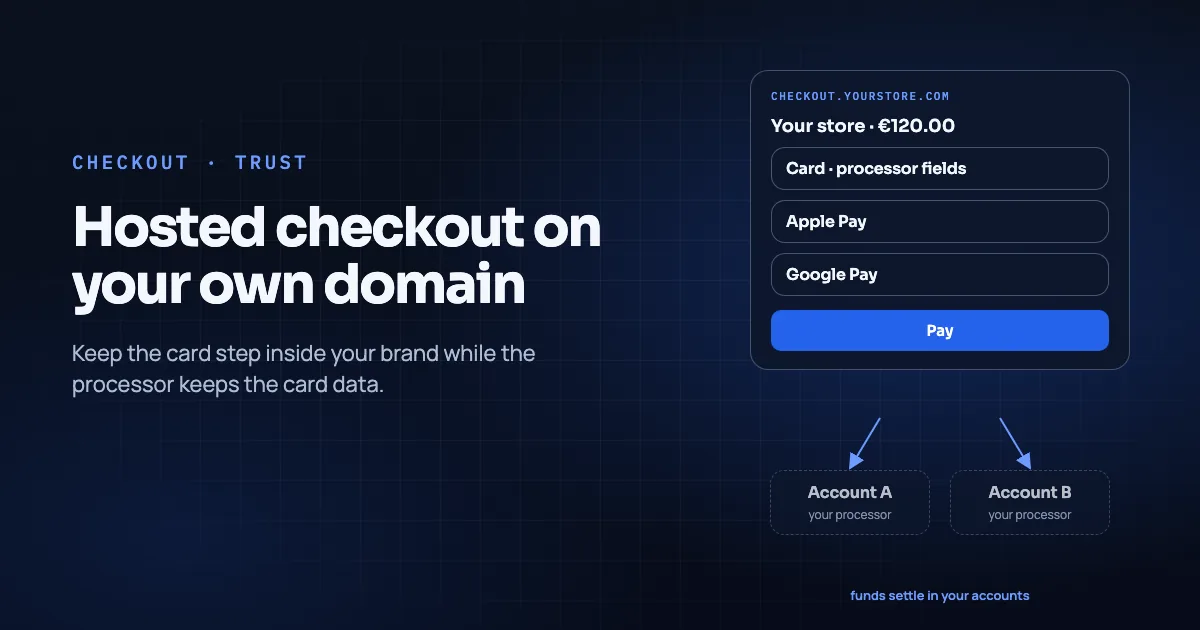
- Temble's published checkout is hosted on your own subdomain, from the card form through the thank-you page. The homepage also names Apple Pay, Google Pay, Shop Pay and Klarna, and mentions promo codes and one-click upsells (Temble homepage, retrieved 2026-11-09).
- Card numbers are collected by the processor's fields, not Temble servers (Temble homepage, retrieved 2026-11-09).
- On Shopify, keep platform checkout rules in mind; see the Shopify routing guide. On Woo, confirm theme handoff; see the WooCommerce routing guide.
In this guide
- Three checkout shapes
- What actually changes for trust
- What stays with the processor (PCI reality)
- Routing and hosted checkout together
- Off-domain redirects: when they are still fine
- Implementation checklist
- Platform notes
- Measuring without inventing results
- Copy and UX details that matter more than gradients
- When to postpone a checkout redesign
- Frequently asked questions
- Conclusion
Three checkout shapes
| Shape | Where the card UI lives | Typical trade-off |
|---|---|---|
| Redirect | Provider's domain (pay.provider.com) | Fast to wire; weakest brand continuity |
| Embedded fields / Elements | Your page, provider iframes for PAN/CVC | Strong brand; more engineering |
| Hosted on your subdomain | checkout.yourbrand.com (or similar) run as a hosted flow | Brand + less PCI scope than raw PAN handling; depends on vendor |
Temble documents the third shape: "Hosted on your own subdomain, from the card form to the thank-you page" (Temble homepage, retrieved 2026-11-09). The pricing page lists hosted checkout with your subdomain among the inclusions of the weekly platform fee (pricing page, retrieved 2026-11-09).
What actually changes for trust
Visual continuity. Logo, colors, URL bar showing your domain (or subdomain). Shoppers who already trusted the product page are less likely to hit a "who is this?" moment at the payment step.
Support clarity. Receipts, browser history and "where did I pay?" emails match your brand, not a processor name the shopper forgets.
Not magic. Trust also fails on slow pages, surprise fees, forced accounts and weak shipping promises. Baymard ranks several of those above card distrust in the same abandonment work cited above. Fix those too; domain alone will not save a hostile checkout.
This article will not quote an invented uplift like "+X% conversion from subdomain checkout." Measure your own funnel: add-to-cart → checkout start → payment submit → thank-you.
What stays with the processor (PCI reality)
Temble states that card numbers stay with your processor, collected by the processor's fields rather than Temble servers (Temble homepage, retrieved 2026-11-09). That split matters:
- You should still ask for the vendor's PCI attestation scope.
- You should not store raw PANs in your WordPress database "for convenience."
- 3-D Secure challenges may still open issuer UI. That interruption is normal and not a branding failure.
For what a gateway, a processor and orchestration each do, see the plain-language map.
Routing and hosted checkout together
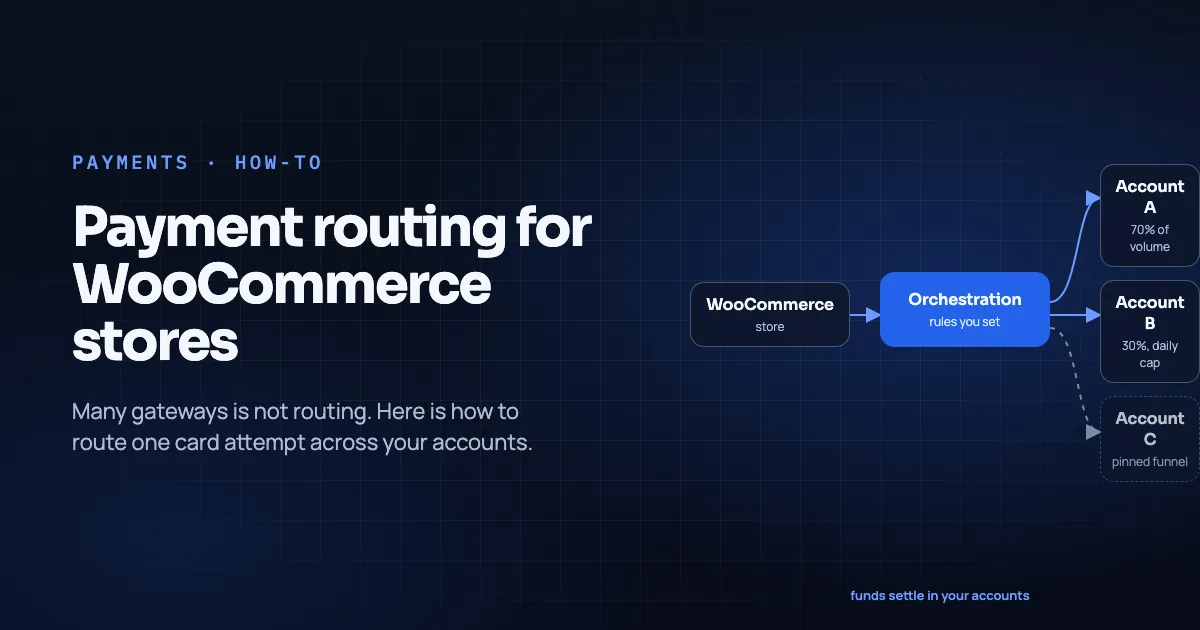
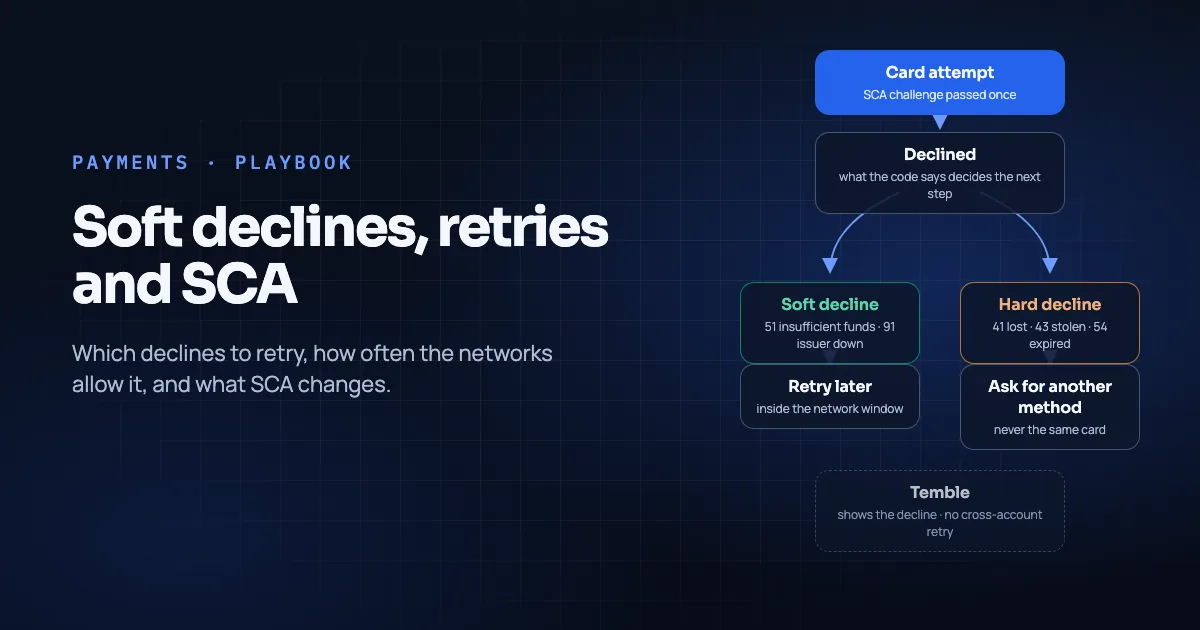
Hosted checkout without routing is still a single-account story. Hosted checkout with routing lets the branded step sit in front of multiple accounts you own. Splits, caps and pins fire before the charge (routing rules). Declines still surface to the shopper on Temble, with no silent hop to another account (Temble homepage; retries playbook).
That combination (branded path, chooser layer, non-custodial settlement) is the product shape Temble describes on its homepage.
Off-domain redirects: when they are still fine
Redirects can be acceptable when:
- The method requires it (some local APMs and bank flows).
- The shopper already expects the brand (PayPal, major wallets).
- You measured no worse completion than embedded alternatives for that method.
They are a poor default for your primary card path if a subdomain-hosted or embedded option exists and your audience is brand-sensitive.
Implementation checklist
- Pick the subdomain (e.g.
pay./checkout.) and TLS certificate owner. - Confirm DNS and cookie behavior on staging.
- Match brand tokens (logo, primary color, fonts) to the storefront.
- Test Apple Pay / Google Pay eligibility on allowed browsers/devices if you enable them (Temble homepage lists them among built-in wallets).
- Test promo codes and upsells if you use Temble offers (pricing page lists discount codes and one-click upsells).
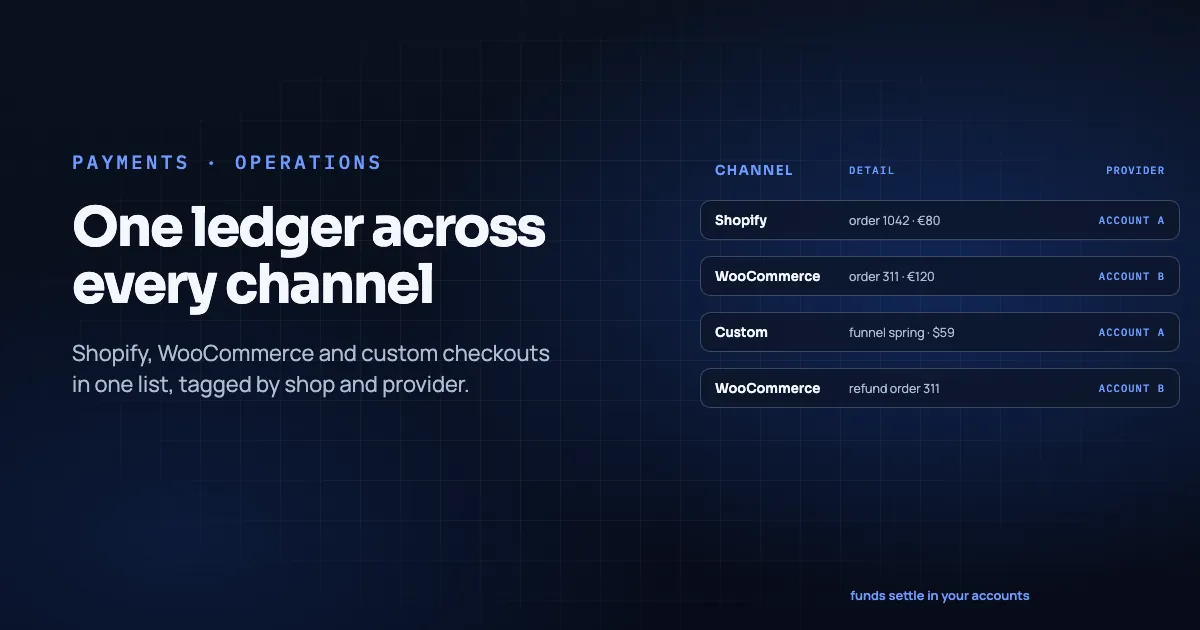
- Confirm order handoff back to Shopify or WooCommerce and that the ledger tags the shop.
- Run an EU card through SCA; confirm the decline path copy is human.
Platform notes
Shopify. External providers that send shoppers off-store can conflict with how you want brand and terms to work. The Shopify routing guide covers direct vs external provider behavior and checkout terms at length. Read it before you replace card capture with a naked redirect.
WooCommerce. Theme and block checkout combinations vary. Prefer a staging clone; verify emails and order statuses after hosted payment return (Woo guide).
Custom / API. Temble documents custom storefronts via signed checkout API and webhooks (Temble homepage). The same subdomain branding goals apply; do not rebuild a second untracked payment page that skips the ledger.
Measuring without inventing results
Track for two weeks before/after a checkout change:
- Checkout start → payment submit rate.
- Payment submit → success rate (auth).
- Soft-decline share and recovery via second method.
- Support tickets tagged "is this site legit?" / payment domain confusion.
Report raw counts and rates for your store only. Skip industry folklore.
Copy and UX details that matter more than gradients
- Decline messages: say the payment did not go through; offer another method; avoid blaming the shopper. Tie to the soft-declines playbook.
- Loading states: a blank iframe while the processor fields load reads as a broken site; show a branded skeleton.
- Order summary: show total, shipping and taxes before the card fields when your platform allows. Surprise totals drive abandonment regardless of domain.
- Return URLs: broken thank-you links create duplicate attempts and support load; test failure URLs as carefully as success.
- Accessibility: labels on every field, keyboard focus into processor iframes where possible, sufficient contrast on your chrome around the fields.
None of these require a new vendor. They determine whether "hosted on your subdomain" feels premium or unfinished.
When to postpone a checkout redesign
Do not relaunch hosted checkout in the same week as a provider migration, a major theme rewrite and a pricing change. You will not know which lever moved the funnel. Sequence: stable catalog and shipping → connect routing destinations → switch checkout path → then iterate on upsells and offers listed on the pricing page.
Frequently asked questions
Is a subdomain enough to claim "on my domain"?
It is still your DNS zone and brand if you control it. Some teams prefer an apex path; ask what the vendor supports. Temble's public language is subdomain (Temble homepage).
Does hosted checkout mean Temble stores cards?
Temble says card numbers are collected by the processor's fields and stay with the processor (Temble homepage). Confirm PCI scope in onboarding.
Will this raise conversion?
It can remove a trust cliff; it cannot overcome price or shipping surprises. Measure your funnel. Do not trust a vendor percentage without methodology.
Conclusion
Hosted checkout on your subdomain keeps the highest-anxiety step inside your brand while leaving PAN handling with the processor. Pair it with routing only when you truly have multiple accounts to choose among, and keep decline behavior honest.
See pricing for inclusions, or book a demo to walk a subdomain checkout on your stack.
About the author. Mattieux Rinot is an SEO Expert at Temble. Temble is a payment orchestration layer that routes payments across a merchant's own accounts and never holds the funds. Mattieux has five years of experience across CRM, customer success and payment processing.
Corrections. Send errors via the contact page; we add a dated update note.
Sources
- Baymard Institute cart abandonment reasons (2022 survey, n=4,384), as cited in Temble: Payment Routing on Shopify
- Temble homepage, pricing page, retrieved 2026-11-09
- Payment Gateway vs PSP vs Orchestration, How to Write Routing Rules, Soft Declines, Retries, and SCA, Payment Routing on Shopify, Payment Routing on WooCommerce, One Ledger