
A risk-review or reserve email is a deadline with poor timing. Payouts may already be slower. The store owner is the only person who can see some of the notices. This checklist is ops hygiene: gather what official processes already ask for, so you are not hunting supplier invoices at midnight.
It is not a playbook for beating underwriting, hiding a vertical, or guaranteeing that a reserve will be released. Temble does not write your appeal and does not release funds held at a processor.
Key Takeaways
- Shopify says the store-owner email and the admin notice are the primary instructions for holds (Shopify Help: Account holds, retrieved 2026-11-10). Reply with the information requested, promptly.
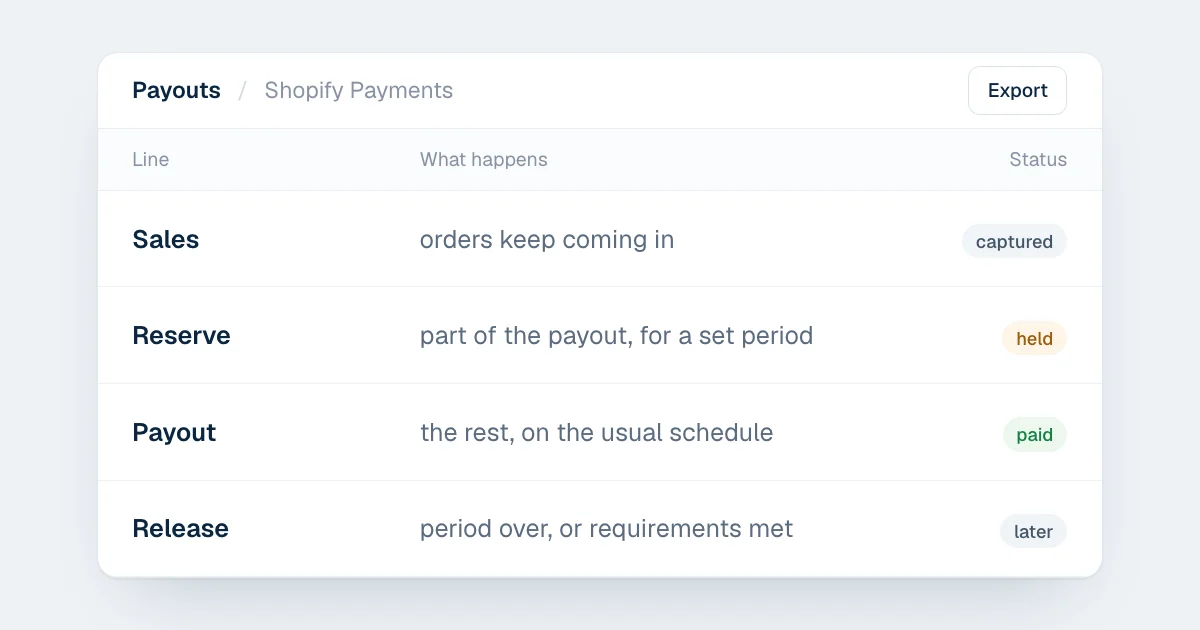
- To appeal a reserve, Shopify says to reply to the email that set out the reserve terms within the specified window. Some reserves cannot be appealed. If the email lists requirements for removal instead of inviting an appeal, Shopify says the reserve cannot be appealed by reply. It is removed automatically once you meet those requirements (Shopify Help: Reserves, retrieved 2026-11-10).
- High-value-goods reviews may require a questionnaire and supporting documents in the admin; missing the date can mean setting up an alternative payment provider (Shopify Help: Account holds).
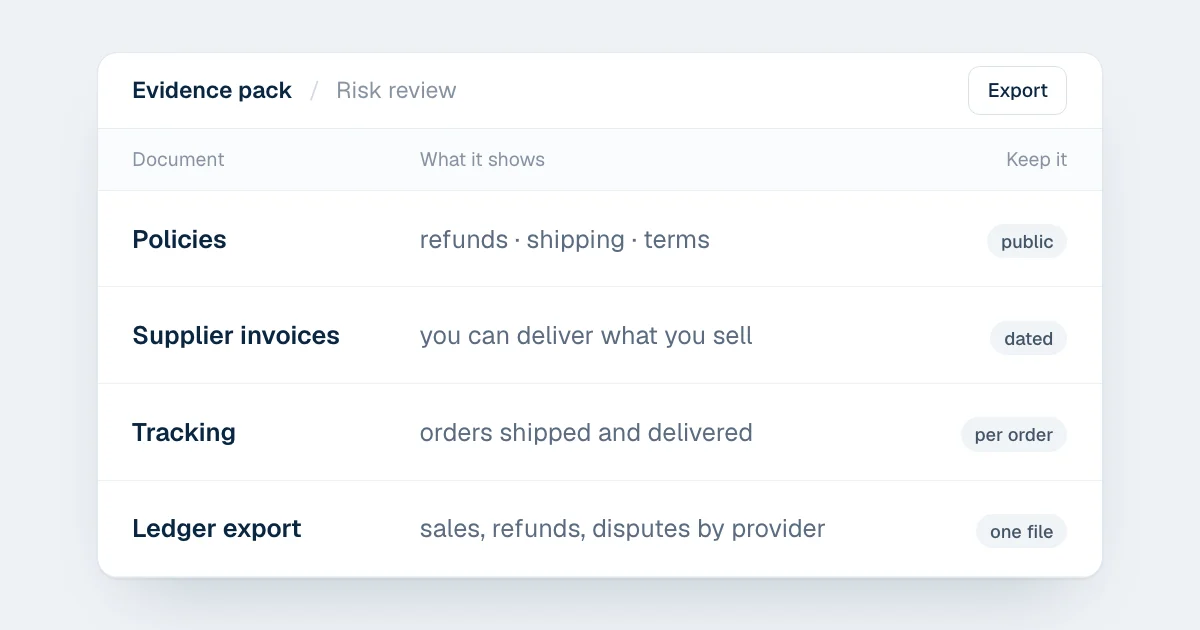
- Keep a standing folder: legal identity, policies, suppliers, inventory, tracking, billing terms, and a ledger export. Update it quarterly.
- Temble onboarding confirms processing rates in writing from business model, expected volume, history and risk (pricing page, retrieved 2026-11-10). Ledger exports can support your transaction story. They are not an appeal letter.
In this guide
- Read the notice before you build a narrative
- The standing folder
- How to answer when the email lands
- What Temble can contribute (and cannot)
- Frequently asked questions
- Conclusion
Read the notice before you build a narrative
Holds, reserves, payout delays and deactivation are different states. Shopify's acceptable-practices page lists them as possible actions for elevated risk (Shopify Help: Acceptable business practices, retrieved 2026-11-10).
The hold page adds that in most cases customers can still check out while payouts are on hold. You will not be paid until the hold is resolved, and in some cases new orders cannot be accepted (Shopify Help: Account holds, retrieved 2026-11-10). Confirm which case applies in the banner or the owner email.
Only the store owner can access some Shopify Payments details. Staff may see a generic prompt to contact the owner (same page). Put the owner mailbox on a monitored device, and check spam.
Verify that the email is genuine before you click links or send bank documents. Shopify points to its phishing guidance from the hold article (same page). When in doubt, open the admin from a bookmark, not from the message.
Official Shopify wording is the checklist. Anecdotes from other merchants (invoices, dated inventory photos, and similar) can hint at what a review might request. They are not a policy and not a statistic.
The standing folder
Create one place (a restricted drive, not a public Slack channel) with dated subfolders. Refresh after any major catalog or entity change.
1. Identity and bank
- Company registration, beneficial owners, IDs already used at onboarding.
- VAT / tax IDs as filed.
- Bank letter or voided check matching the payout account name.
- Addresses that match the site footer and the processor profile.
2. What you sell
- Current product URLs, not just a PDF deck.
- Claims, certifications and testimonials you actually show. They should be verifiable. Shopify reviews accuracy of descriptions and authenticity of reviews (Shopify Help: Acceptable business practices).
- If you sell high-value goods, expect questions in the admin first. Shopify's examples include loose diamonds, gold bullion and coins, jewelry, art, designer goods and watches. Depending on your answers, expect a more detailed questionnaire and supporting documents, or remove the goods (Shopify Help: Account holds, retrieved 2026-11-10).
3. How you fulfill
- Supplier invoices and contracts (redact pricing if you must, not the supplier identity if they asked for it).
- Dated inventory photos or warehouse receipts when stock is the question.
- Typical and worst-case lead times, especially for pre-orders and custom work.
- A sample of tracking numbers for recent fulfilled orders.
4. How you bill and support
- Refund, return and cancellation policy as published.
- For subscriptions: terms, renewal, cancel path (subscription risk).
- Support SLAs and a few anonymized ticket examples that show you answer.
5. Payments evidence
- 30–90 days of payout reports from each provider.
- A ledger export with shop, provider, status, amount and currency, refunds included. Temble's published ledger is one list across channels with the shop named, plus refunds and exports (pricing page, retrieved 2026-11-10).
- Chargeback and refund counts from the processor's own dashboard (do not invent a ratio here).
- Descriptor text as it appears on statements.
6. The letter they already sent
- Save the original reserve or hold email as a PDF. Reserve appeals, when allowed, go as a reply to that thread within the window (Shopify Help: Reserves).
How to answer when the email lands
- Assign one owner (usually the legal store owner plus finance).
- Answer every requested item, labeled to match their list. Do not send a brand manifesto instead of the documents.
- If a reserve email lists requirements for automatic removal rather than an appeal invitation, Shopify says the reserve cannot be appealed by reply (Shopify Help: Reserves, retrieved 2026-11-10). Meet the requirements and wait for the process described.
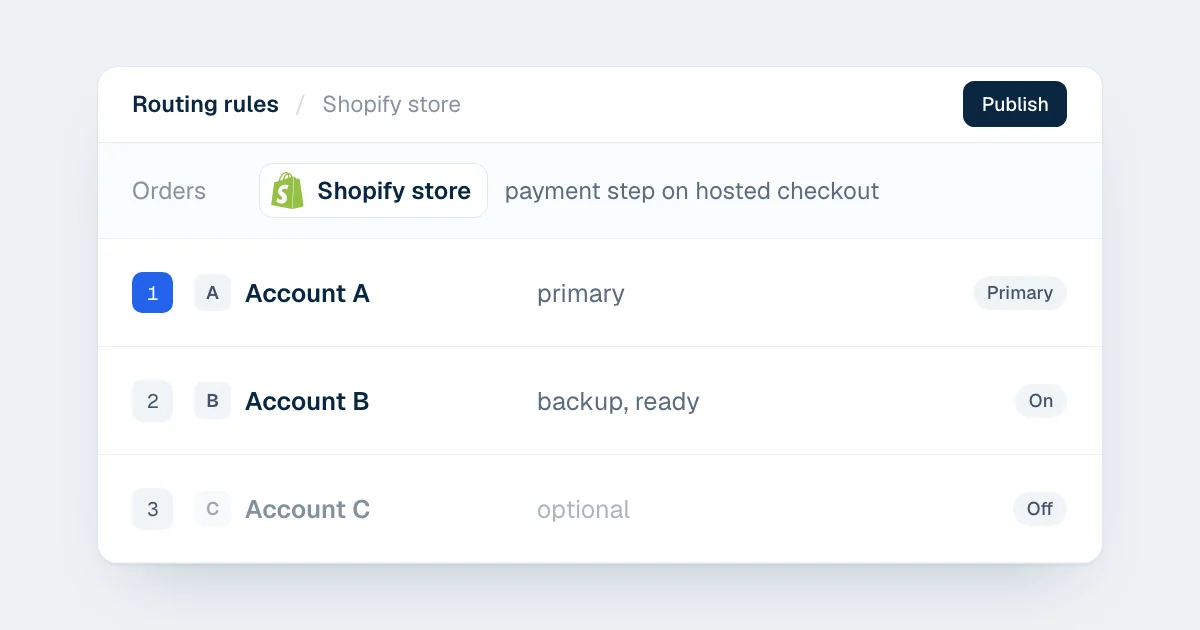
- Keep selling only if checkout is still on. If charges are deactivated, follow that notice. Shopify documents activating a third-party provider as an option after decline or deactivation (acceptable business practices). A backup account should have been boarded earlier: Shopify Payments Disabled or On Hold.
- Do not change your product claims or "reposition" the catalog in a way that misrepresents the business while a review is open.
What Temble can contribute (and cannot)
Temble confirms your processing rate in writing at onboarding, from business model, expected volume, history and risk (pricing page, retrieved 2026-11-10). Keep that confirmation with the pack.
If you already run Temble, a ledger export is a convenient transaction list across Shopify, WooCommerce and custom checkouts. It can show which connected account captured an order while a reserve is active on another. It is not a reserve-release tool. Funds settle in your connected accounts; there is no Temble balance (Temble homepage, retrieved 2026-11-10).
Temble does not write your Shopify or Stripe appeal. That work is yours, with your counsel or accountant if you use one.
Frequently asked questions
How long should I keep the folder?
At least as long as your processors can reopen reviews, and long enough to cover typical dispute windows on delayed fulfillment. When in doubt, keep the current year plus the previous one, and archive rather than delete.
Can I send screenshots instead of CSVs?
Send what they asked for. Screenshots help context; payout reports and invoice PDFs travel better. A ledger CSV is useful when they want volume by day or by shop.
Will a complete pack prevent a reserve?
No guarantee. It can shorten a review that would otherwise stall for missing documents. Reserves are a risk decision, described in the reserves guide.
Conclusion
The cheapest time to build an evidence pack is before anyone asks. Official Shopify hold and reserve processes already tell you who must reply. They also say what a high-value-goods review can demand and when an appeal is even available. Fill the folder on a quiet week: identity, catalog, suppliers, tracking, policies, payouts and a clean export.
When the email arrives, follow that email. Do not invent a workaround. Do not wait on a vendor that never held the funds to unlock a reserve it does not control.
If you want to see what a Temble ledger export looks like for this kind of pack, book a 30-minute walkthrough.
About the author. Mattieux Rinot is an SEO Expert at Temble. Temble is a payment orchestration layer that routes payments across a merchant's own accounts and never holds the funds. Mattieux has five years of experience across CRM, customer success and payment processing.
Corrections. Errors go to the contact page; we fix them with a dated update note.
Sources
- Shopify Help: Shopify Payments account holds (owner email, requested information, high-value goods, checkout during holds), retrieved 2026-11-10
- Shopify Help: Overview of reserves in Shopify Payments (appeal window; automatic-removal requirements), retrieved 2026-11-10
- Shopify Help: Acceptable business practices and risk evaluation, retrieved 2026-11-10
- pricing page (rate confirmed in writing; ledger exports), retrieved 2026-11-10
- Temble homepage (non-custody), retrieved 2026-11-10
- One Ledger Across Shopify, WooCommerce, and Custom Checkouts
- When Shopify Payments Puts a Reserve on Your Payouts