A declined card is not always a lost sale, and not every decline should be retried. Here is a practical playbook for soft declines, retry limits and SCA when you run more than one payment account.
This guide is for founders and operations leads who already hold, or are opening, more than one payment account. Those accounts sit behind Shopify, WooCommerce or a custom storefront. It separates soft declines from hard ones and covers network retry limits. It also explains why Strong Customer Authentication (SCA) changes what a "retry" is allowed to do in the EU and UK. It does not promise an authorization-rate lift.
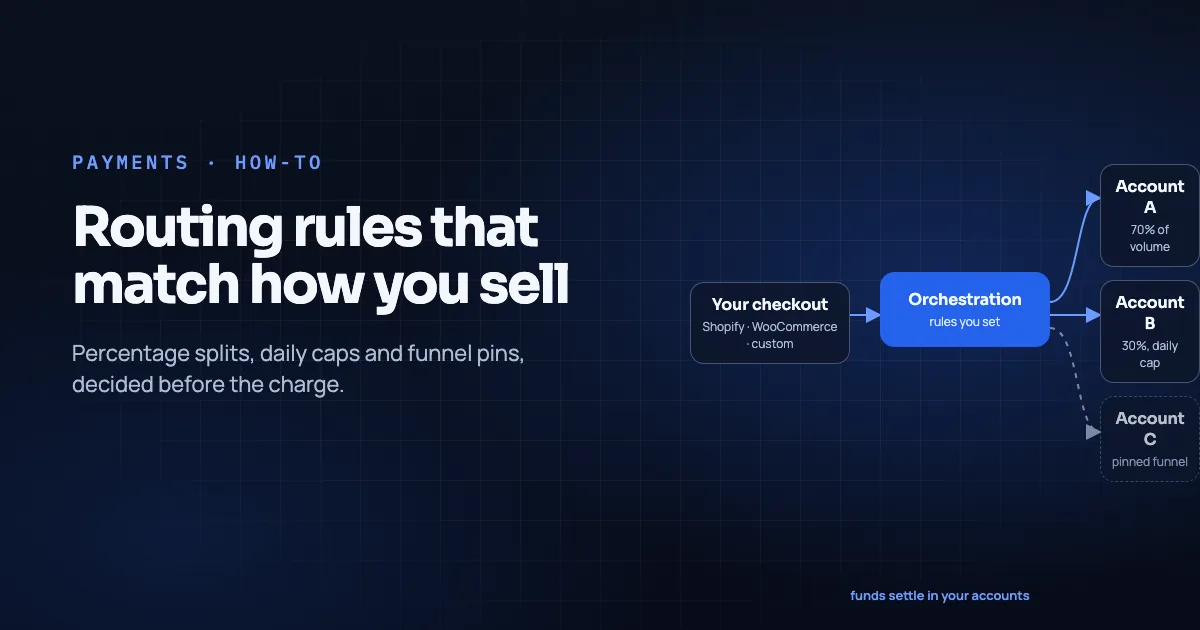
Important product fact: Temble does not retry a declined card on another account. A declined card is shown to the shopper and stays declined (Temble homepage, retrieved 2026-11-09). If you need automatic cross-account failover after a soft decline, that is a different vendor capability. Verify it in a sandbox. Temble still helps by choosing which account attempts the charge before it runs. See How to Write Routing Rules and What Is Payment Orchestration.
Key Takeaways
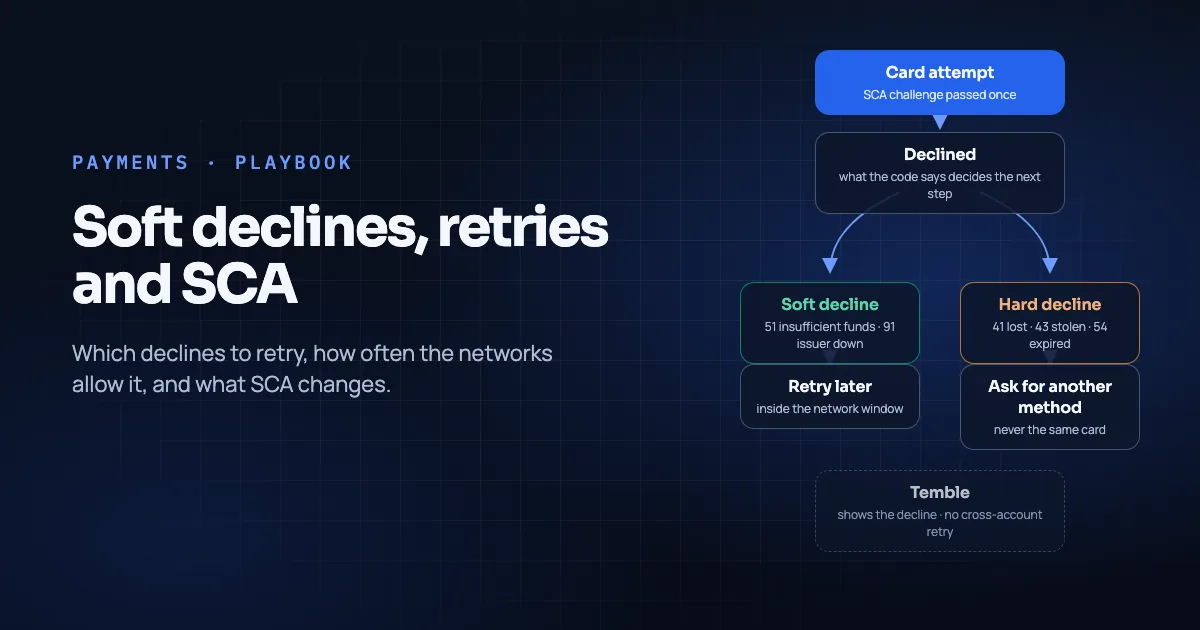
- Soft declines are temporary (e.g. insufficient funds, issuer unavailable). Hard declines are permanent blocks (e.g. lost or stolen card) and should not be retried on the same card (Stripe, updated 2026-11-03).
- Many card networks allow only about 4 to 6 retries within a 15-day window on a declined transaction (Stripe optimizing authorization rates, retrieved 2026-11-09). Burning those attempts on hard declines helps nobody.
- In the EU, Commission Delegated Regulation (EU) 2018/389 sets regulatory technical standards for strong customer authentication (EUR-Lex). A retry must not casually force a shopper through a second challenge they already passed. Confirm handling with your provider. This is not legal advice.
- Temble routes before the charge and does not cross-retry declines onto another account (Temble homepage, retrieved 2026-11-09).
In this guide
- Soft decline vs hard decline
- What "retry" can mean (three different jobs)
- Network limits: do not burn the window
- SCA: why Europe and the UK change the retry story
- Playbook for multi-account merchants
- What not to do
- Frequently asked questions
- Conclusion
Soft decline vs hard decline
Stripe groups declines into two practical buckets (Stripe, updated 2026-11-03):
| Soft decline | Hard decline | |
|---|---|---|
| Meaning | Temporary; a later attempt or another method may succeed | Permanent block for this card / this attempt path |
| Examples | Code 51 insufficient funds; Code 91 issuer unavailable | Code 41 lost card; Code 43 stolen card; Code 54 expired card |
| Action | Retry later, or offer another method | Do not retry the same card; ask for another method |
"05 Do not honor" is a generic catch-all. Stripe notes issuers use it for many reasons and may hide the real cause (Stripe optimizing authorization rates). Treat bare "do not honor" as soft only when your provider's advice says retry is allowed. Stripe's API surfaces advice such as try_again_later versus do_not_try_again (Stripe docs: card declines, retrieved 2026-11-09).
Online authorization rates can be 10% lower than in person, because issuers apply more conservative fraud logic on card-not-present traffic (Stripe). That is a Stripe-stated industry pattern, not a forecast for your store.
What "retry" can mean (three different jobs)
Merchants mix three ideas under one word:
- Shopper retry: the person tries again, or picks another method, after seeing a decline message.
- Same-account / same-provider retry: your PSP reattempts later (common in subscriptions / dunning), still on that provider.
- Cross-account failover: a soft decline on Account A is immediately sent to Account B by a routing layer.
Only (3) is "orchestration failover." Temble does not do (3). Declines stay declined at the shopper (Temble homepage, retrieved 2026-11-09). You can still improve (1) with clearer decline UX and alternate methods, and (2) inside each connected PSP if that PSP offers it. Routing rules still matter before any retry happens: they put the first attempt on the right account. See routing rules.
Network limits: do not burn the window
Stripe's authorization guide states that many card networks only allow 4 to 6 retries within a 15-day window (Stripe, retrieved 2026-11-09). Stripe's decline docs separately recommend a maximum of eight retries for charges that permit retries. They also warn that extra attempts can look like fraud to issuers (Stripe docs). Treat those as vendor guidance. Your network contracts and your provider's settings win if they are stricter.
Practical rules to write down:
- Retry soft codes only (or codes your provider marks
try_again_later). - Never retry lost, stolen, pickup, fraudulent, or expired-card hard codes on the same PAN.
- Cap retries per card well inside the network window.
- Log every attempt: original code, advice, account used, result, timestamp.
SCA: why Europe and the UK change the retry story
In the EU, Commission Delegated Regulation (EU) 2018/389 supplements PSD2 with regulatory technical standards for strong customer authentication and secure communication (EUR-Lex, consolidated text retrieved 2026-11-09). SCA generally means authentication based on two or more elements from knowledge, possession and inherence.
What that means for retries, in plain operations language (not legal advice):
- A first attempt may have already completed a 3-D Secure challenge.
- Blindly re-presenting the same payment on another acquirer can trigger a second challenge, or fail authentication. The outcome depends on how exemptions and 3RI / MIT handling are implemented.
- Before you buy any cross-account retry product, ask in writing. Does a soft-decline failover reuse the first authentication, request an exemption, or start a new challenge?
Confirm UK applicability with your provider and counsel. UK ecommerce SCA timelines were set through the FCA's SCA programme. The existing Temble Shopify guide cites the FCA's 14 March 2022 ecommerce deadline. When in doubt, treat SCA as in scope for remote card payments to EU/UK shoppers and test EU cards in staging.
Playbook for multi-account merchants
Step 1: Baseline (one week of exports)
Export attempts from every account for the same period. Columns you need: decline code, advice (if any), issuer country, currency, amount, first attempt vs retry, and which account.
Compute, per account: authorization rate on first attempts; top decline codes; share of soft vs hard (using your code list).
Step 2: Write a soft-code allowlist
Start narrow: insufficient funds, issuer unavailable, processing error, plus whatever your PSP documents as retryable. Keep "do not honor" out until advice codes justify it.
Step 3: Decide which retry jobs you actually want
| Job | Who owns it | Temble today |
|---|---|---|
| Clear decline message + alternate method | Your checkout / store | Hosted checkout can present the decline; no auto failover (Temble homepage) |
| Delayed dunning on subscriptions | The PSP that holds the mandate | Depends on the connected account |
| Immediate failover A → B | Orchestration vendor | Not offered: decline stays with the shopper |
If failover A → B is mandatory for you, shortlist vendors that document it, and still apply the soft-only + SCA tests above.
Step 4: Put the first attempt in the right place
Even without cross-retries, routing can reduce avoidable soft declines when Account B is simply the wrong acquirer for that market or risk profile. Use pins and caps before the charge (routing rules; Shopify guide; WooCommerce guide).
Step 5: Measure for two weeks
Track: first-attempt auth rate; soft-decline share; shopper-recovery rate (paid on a second method after a decline); any same-account dunning recovery. Do not invent a "routing lift" without a dated baseline.
What not to do
- Retry hard declines "just in case."
- Fire five rapid retries into the 15-day window.
- Assume your orchestration layer fails over. Ask, and for Temble the answer is no (Temble homepage).
- Skip SCA testing for EU/UK cards if you sell there.
- Compare your auth rate to a vendor homepage percentage. Vendor populations are not your store.
Frequently asked questions
Should I retry a declined card?
Only if the decline is soft (or advice says try later). Hard declines need another payment method (Stripe).
Does Temble retry on another account after a soft decline?
No. The decline is shown to the shopper and is not retried elsewhere (Temble homepage, retrieved 2026-11-09).
Will better routing raise my authorization rate?
Nobody can promise that here. Routing can place the first attempt on a better-fit account. Measure your baseline first. See orchestration.
Is this legal advice on SCA?
No. Read Regulation (EU) 2018/389 with your provider and counsel.
Conclusion
Soft declines deserve a plan. Hard declines deserve a different payment method. Network windows are finite. SCA makes blind cross-account retries a compliance question, not just a conversion hack.
Temble will choose the account before the charge and will not silently bounce a decline onto a second account. If that honesty matches how you want to operate (rules up front, custody with your providers), book a walkthrough or start with routing rules.
About the author. Mattieux Rinot is an SEO Expert at Temble. Temble is a payment orchestration layer that routes payments across a merchant's own accounts and never holds the funds. Mattieux has five years of experience across CRM, customer success and payment processing.
Corrections. Send errors via the contact page; we add a dated update note.
Sources
- Stripe, Credit card declines, updated 2026-11-03
- Stripe, Optimizing authorization rates, retrieved 2026-11-09
- Stripe Docs, Card declines, retrieved 2026-11-09
- Commission Delegated Regulation (EU) 2018/389 (SCA RTS), EUR-Lex
- Temble homepage (decline behavior, pre-charge routing), retrieved 2026-11-09
- What Is Payment Orchestration, How to Write Routing Rules, Payment Routing on Shopify, Payment Routing on WooCommerce