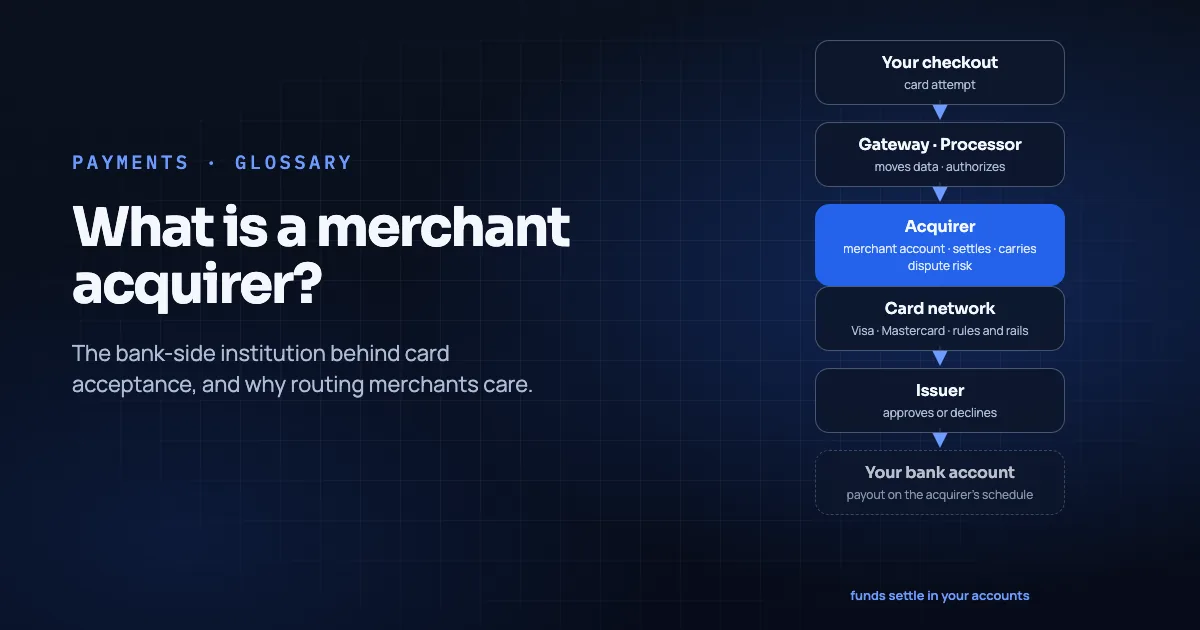
A merchant acquirer (acquiring bank, or acquirer) is the institution that partners with a business so it can accept card payments. It provides or sponsors the merchant account, participates in card-network settlement, and assumes chargeback, fraud and dispute risk on that relationship (Stripe: Payment processor vs. merchant acquirer, updated 2025-04-25).
If you only ever bought a full-stack PSP, you may never have said the word "acquirer" out loud. The role still sits underneath the brand name on your payout. This glossary is for founders and ops leads who are adding a second account or evaluating payment orchestration and need the term pinned down.
Key Takeaways
- The acquirer is the merchant-facing bank side of card acceptance: merchant account, network access and settlement path. It assumes chargeback, fraud and dispute risk (Stripe).
- A processor moves authorization and settlement messaging; a gateway moves payment data from checkout. Many brands bundle several roles (Stripe: processor vs gateway).
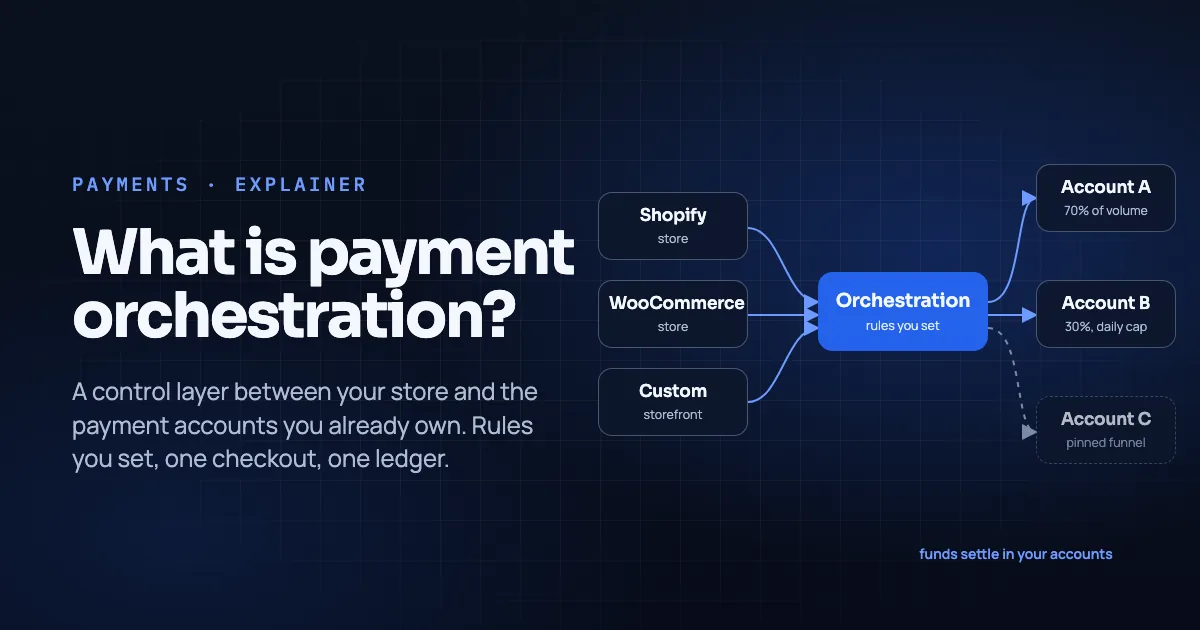
- An orchestration layer does not replace the acquirer. It chooses which of your connected accounts (each with its own acquiring path) attempts a payment.
- Temble connects Stripe and Finix accounts as routing destinations and states it is not an acquirer (integrations directory, retrieved 2026-11-09).
- Routing merchants care because caps, splits and pins only work if each destination can actually acquire the method and currency you send it.
In this guide
- Acquirer in one paragraph
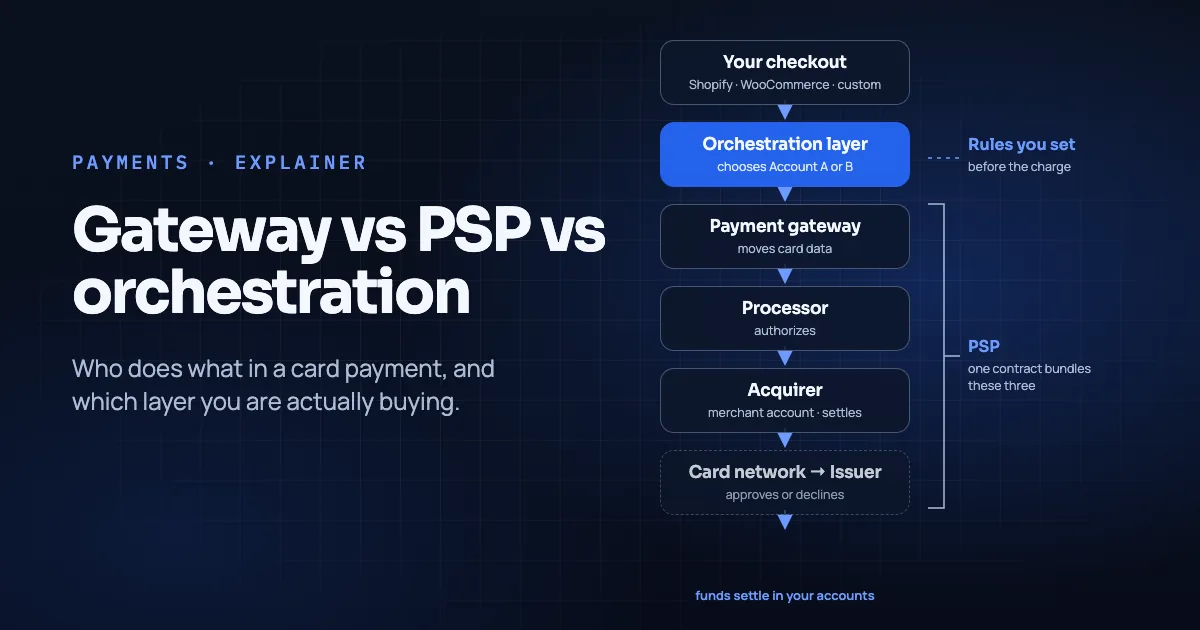
- Acquirer vs processor vs gateway vs PSP
- Why routing merchants care
- Where Temble sits relative to acquiring
- A short vocabulary add-on
- Frequently asked questions
- Conclusion
Acquirer in one paragraph
When a shopper pays by card, the issuer is the shopper's bank. The acquirer is on the merchant's side. It lets the merchant take cards under network rules, helps move settlement into the merchant account, and is exposed when shoppers dispute charges (Stripe, retrieved 2026-11-09).
Without an acquiring relationship somewhere in the stack, there is no merchant account of record for Visa or Mastercard acceptance.
Acquirer vs processor vs gateway vs PSP
Use this map; detail lives in Payment Gateway vs PSP vs Orchestration Layer.
| Role | Plain job |
|---|---|
| Gateway | Securely transmits payment data from checkout toward a processor, the online equivalent of a terminal (Stripe). |
| Processor | Authorizes and helps move settlement data between banks and networks (Stripe). |
| Acquirer | Merchant account relationship, network membership, settlement into that account; assumes chargeback, fraud and dispute risk (Stripe). |
| PSP | Packages gateway and processor (often with acquiring) into one commercial relationship (Stripe). |
| Orchestration | Chooses which of your connected PSP/acquirer stacks attempts the payment; may add one checkout and one ledger. |
One company can wear several hats. Stripe notes it can act as both processor and acquirer so merchants may not maintain a separate acquiring-bank contract (Stripe). When a sales deck says "acquirer," ask whose name is on the merchant account and whose bank account pays you out.
Why routing merchants care
Orchestration is interesting only when you have more than one destination. Each destination still needs acquiring (directly or via a PSP that includes it).
That matters for:
- Method coverage. Account A may acquire cards in the US; Account B may be the one with a given wallet or BNPL enabled. Temble's directory lists methods as via your connected account and states Temble is not an acquirer (integrations directory, retrieved 2026-11-09).
- Risk and volume. Daily caps often exist because an acquiring relationship has limits or commitments. Routing can spill to the next account you named after a cap (Temble homepage, retrieved 2026-11-09). It cannot invent headroom the acquirer did not grant.
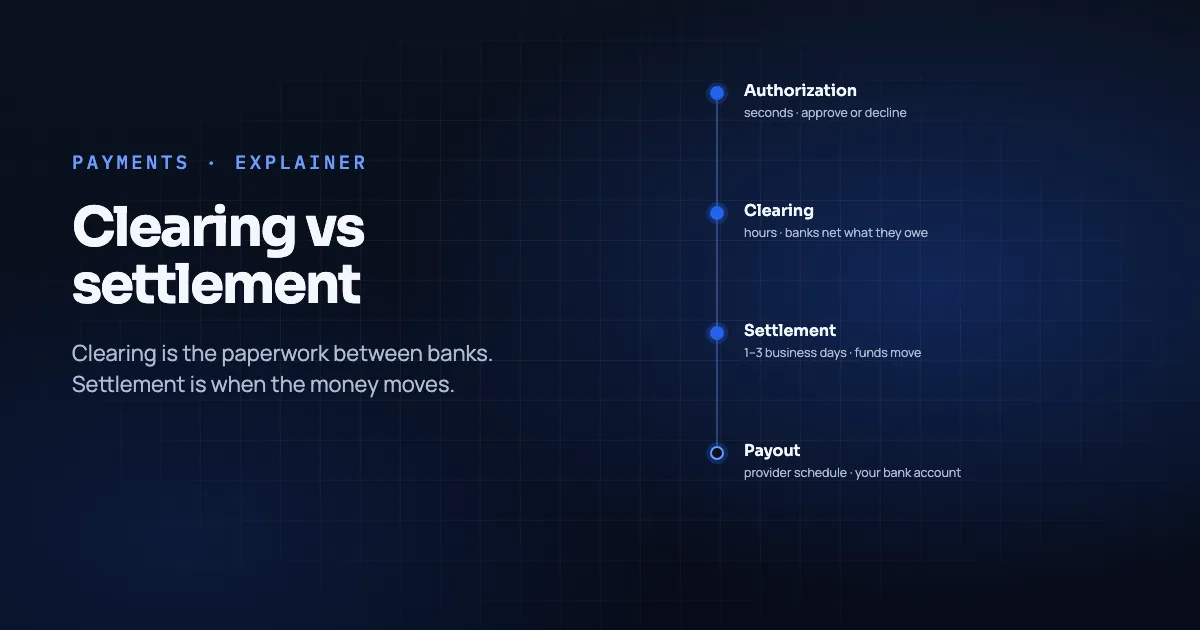
- Settlement and disputes. Chargebacks and payouts stay with the account that captured the payment. A unified ledger helps you see them; it does not merge two acquirers into one risk pool. See Chargebacks vs Refunds and Should You Run Multiple Payment Providers?.
- Custody. In Temble's non-custodial model, each connected provider pays out to the bank account you linked to it; there is no Temble balance (Temble homepage, retrieved 2026-11-09). You still care which acquirer/PSP sits under each connection.
Where Temble sits relative to acquiring
Temble describes itself as payment orchestration: rules, hosted checkout on your subdomain and a unified ledger, without holding merchant funds (Temble homepage, retrieved 2026-11-09). Connectable processors listed Live on the integrations page are Stripe and Finix (integrations directory, retrieved 2026-11-09). Authorization and settlement happen on those accounts. Declines are not retried onto another account (Temble homepage, retrieved 2026-11-09).
Suppose someone asks "who is our acquirer?" after you add Temble. The accurate answer is still "the acquiring path inside each connected Stripe or Finix account," not "Temble."
A short vocabulary add-on
- Merchant account. The account relationship that lets you accept cards; often embedded inside a PSP product.
- MID. Merchant ID, the identifier used in acquiring and reporting; useful when support tickets span two providers.
- PayFac. A model where a platform boards merchants under a master acquiring relationship. Stripe's ecosystem overview groups PayFacs with PSPs that let businesses accept payments without their own direct acquiring-bank relationship (Stripe: payment industry ecosystem, retrieved 2026-11-09). The contract shape differs from a classic bank MID, so read yours.
Frequently asked questions
Is Stripe an acquirer?
Stripe states it can act as both payment processor and acquirer, so you may not need a separate acquiring bank (Stripe). Confirm what your specific Stripe account agreement says.
Do I need a separate acquirer if I use Temble?
You need connected payment accounts that can accept the methods you sell. Temble routes to those accounts; it does not replace them and is not an acquirer (integrations directory, retrieved 2026-11-09).
Is "merchant acquirer" the same as "payment orchestration"?
No. Acquiring accepts and settles. Orchestration chooses among accepting accounts you already hold. See What Is Payment Orchestration.
Conclusion
A merchant acquirer is the merchant-side institution behind card acceptance and settlement. PSPs often bundle that role. Orchestration sits above it when you hold more than one. If you cannot name the acquiring path under each connected account, fix that before you write routing rules.
For Shopify's provider slot while you plan multi-account setups, see the Shopify routing guide. To walk through destinations on your own store, book a 30-minute demo.
About the author. Mattieux Rinot is an SEO Expert at Temble. Temble is a payment orchestration layer that routes payments across a merchant's own accounts and never holds the funds. Mattieux has five years of experience across CRM, customer success and payment processing.
Corrections. Send errors via the contact page; we add a dated update note.
Sources
- Stripe, Payment processor vs. merchant acquirer, updated 2025-04-25
- Stripe, Payment processor vs. payment gateway, updated 2026-05-11
- Stripe, The payment industry ecosystem explained, retrieved 2026-11-09
- Temble homepage, integrations directory, retrieved 2026-11-09
- What Is Payment Orchestration
- Payment Gateway vs PSP vs Orchestration Layer