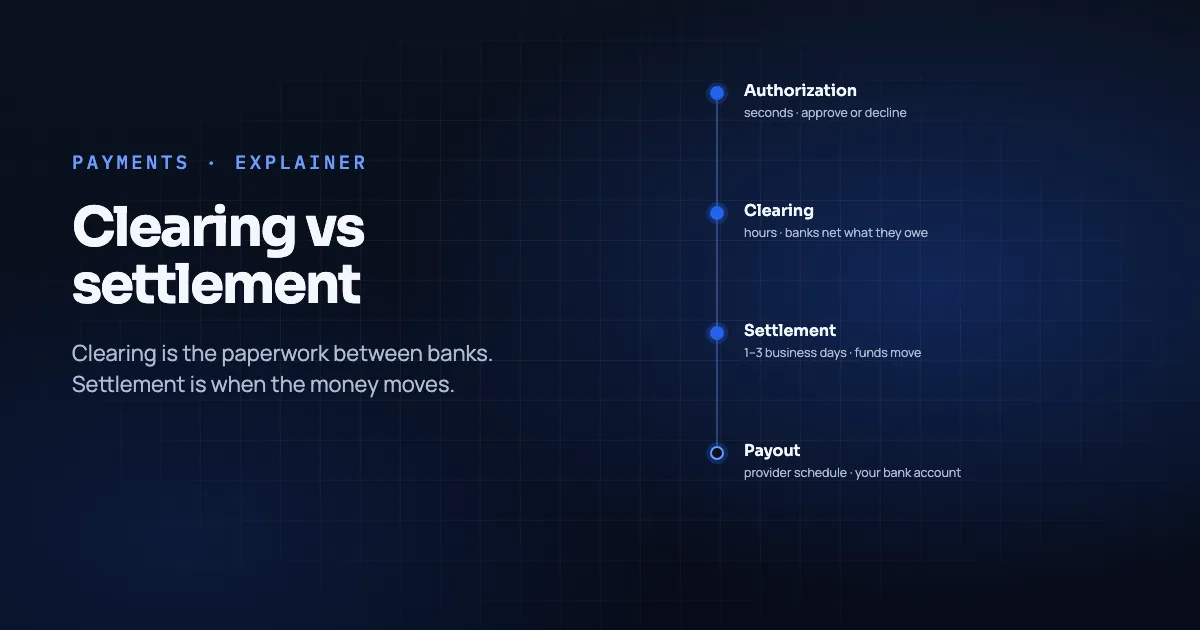
Clearing is the paperwork between banks. Settlement is when funds actually move. Here is where your money goes when the orchestration layer never holds a balance.
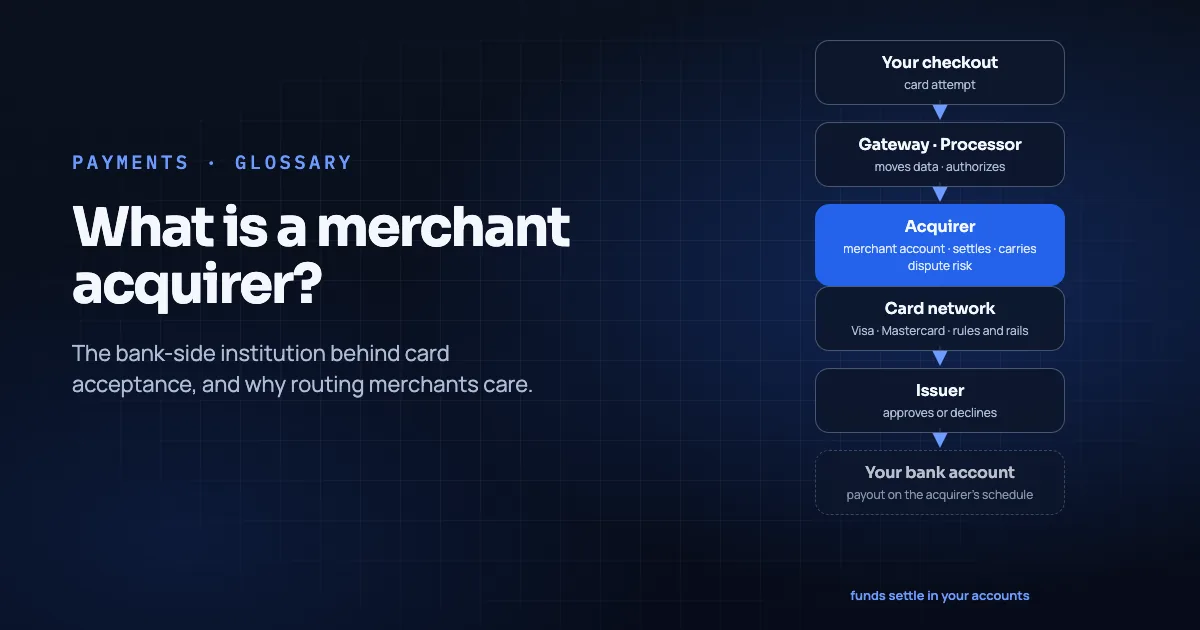
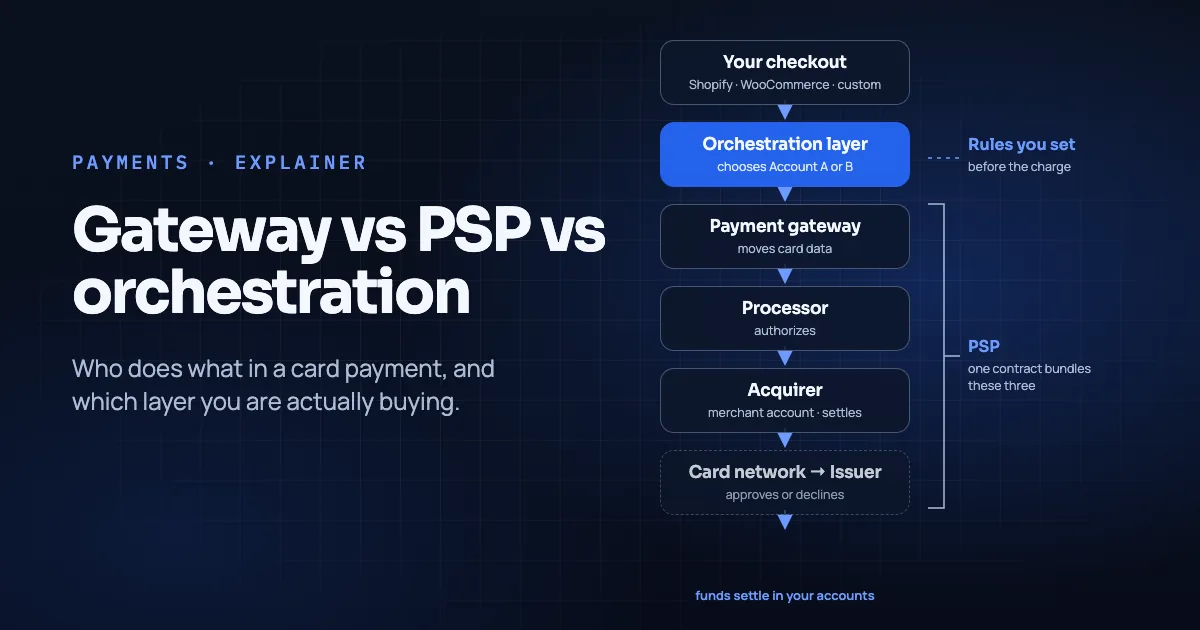
Founders often ask "when do I get paid?" and get three different answers: authorization time, provider payout time, and bank availability. Those are not the same clock. This guide separates clearing from settlement, then shows how a non-custodial stack (your accounts, your payouts) changes what "holding the money" means. For the actor map (gateway, PSP, acquirer), see Payment Gateway vs PSP vs Orchestration Layer.
Key Takeaways
- Clearing verifies the transaction and calculates what institutions owe each other, before money moves (Stripe, updated 2026-09-17).
- Settlement is the transfer of funds between financial institutions that follows clearing (Stripe).
- Card payments are often authorized in seconds, then settle on a longer cycle. Stripe describes settlement commonly in the one-to-three business day range after clearing, depending on network and banks (Stripe).
- Your payout date is often the PSP's calendar, not the exact network settlement instant (Stripe FAQ in the same article).
- On Temble, there is no Temble balance for your revenue; connected providers capture and pay out to banks you linked. The platform fee is an application fee (Temble homepage, retrieved 2026-11-09).
In this guide
- Authorization, clearing, settlement, payout
- The card path after "Pay"
- Custodial vs non-custodial: who sits on the money
- Why the distinction matters operationally
- A hypothetical money-flow (mechanics only)
- Payout schedules are not settlement clocks
- Questions to ask any vendor
- Frequently asked questions
- Conclusion
Authorization, clearing, settlement, payout
Four words, four moments:
| Moment | What happens | What you see |
|---|---|---|
| Authorization | Issuer approves or declines in real time; funds may be reserved | Approve / decline at checkout |
| Clearing | Banks/networks verify and net obligations; money has not moved yet | Often invisible; batch behind the scenes |
| Settlement | Funds move between institutions (issuer ↔ network ↔ acquirer) | Merchant account balance updates at the acquirer/PSP |
| Payout | Provider sends usable funds to your business bank on its schedule | Deposit on your bank statement |
Stripe's clearing-vs-settlement explainer puts it cleanly: clearing verifies and calculates; settlement transfers (Stripe, updated 2026-09-17). Authorization is earlier still: the decline/approve step at checkout (Stripe on declines vs settlement).
The card path after "Pay"
For a typical card payment, Stripe describes this sequence (Stripe):
- Authorization: provider → network → issuer; approve or decline.
- Clearing: acquirer batches the day's transactions to the network; issuer matches them to authorizations and calculates interchange.
- Settlement: issuer funds move through the network; acquirer receives the net amount for that batch.
Visa describes a related flow in its merchant acceptance materials: authorization through VisaNet, then clearing and settlement between acquirer and issuer (Visa: accept Visa payments, retrieved 2026-11-09). Schemes differ in plumbing; the mental model is the same: approve first, move money later.
Checkout approve
  → (hours) clearing / netting between banks
    → (often 1–3 business days) settlement into merchant account at acquirer/PSP
      → (provider schedule) payout to your business bank
Stripe notes clearing often completes within hours of batch submission. In its description of the pattern, settlement follows one to three business days later for cards (Stripe). Your vertical, geography and provider can differ, so read your payout docs.
Custodial vs non-custodial: who sits on the money
Custodial processor (simplified): the provider settles into a balance it controls, then pays you. You may see a "balance" in their dashboard before a bank payout. That can be convenient. It also means a vendor balance is part of your cash-flow path.
Non-custodial orchestration (Temble's published model): Temble never holds merchant funds. Payments are captured by your connected accounts and paid out on those processors' schedules. There is no Temble balance; the platform fee is taken as an application fee on the transaction (Temble homepage, retrieved 2026-11-09). Card numbers stay with the processor's fields, not Temble servers (Temble homepage).
So when you ask "where is my money?" under Temble, the honest answer is simple. It sits in the settlement and payout path of whichever connected account took the charge. That means Account A's Stripe or Finix payout, not a Temble wallet. The ledger is how you see those paths in one list; it is not a bank account.
Why the distinction matters operationally
Cash-flow planning. A strong sales day is not the same as same-day usable cash. Stripe warns that ignoring clearing and settlement leads people to overestimate short-term liquidity (Stripe).
Multi-account reality. Two accounts mean two settlement calendars. A pin that sends EU volume to Account B also sends that volume onto B's payout timing. Caps that spill to Account A at midnight can split one campaign across two bank deposits. Your ledger should make that visible.
Disputes after settlement. Chargebacks can reverse funds after settlement, on a separate network timeline (Stripe). The custody model does not remove chargeback risk; it changes whose balance is debited first.
Reversibility. Stripe notes mismatches are easier to pull during clearing than after settlement, when a dispute process is required (Stripe).
A hypothetical money-flow (mechanics only)
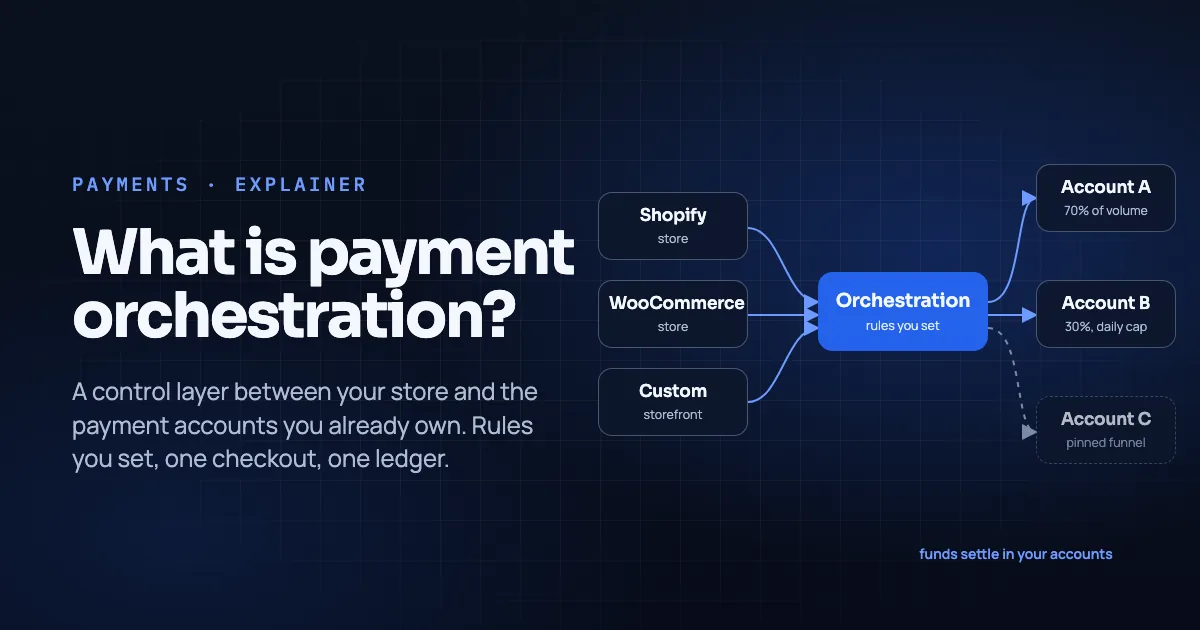
You connect Account A and Account B to Temble. An order for $180 is routed to Account A by a percentage split. The route is chosen before the charge (Temble homepage).
- Shopper is approved at checkout (authorization).
- Account A's acquirer/PSP clears and settles on its network schedule.
- Account A pays out to the US bank account you linked to Account A.
- Temble's application fee is collected on the payment itself; no Temble balance holds the $180 (Temble homepage).
- Your Temble ledger row names the shop and Account A for reconciliation (pricing page).
If the same order had been pinned to Account B, settlement and payout would follow B's calendar to B's bank. Temble still would not sit in the middle as custodian.
This example shows mechanics only. It does not predict payout speed or fees.
Payout schedules are not settlement clocks
Stripe's FAQ on the same topic is blunt. Your payout date likely reflects the payments provider's own schedule rather than the precise settlement timing of each transaction (Stripe, updated 2026-09-17). Providers often smooth day-to-day settlement variability into a predictable calendar.
That matters twice when you orchestrate:
- Comparing accounts. Account A paying daily and Account B paying weekly will make "revenue yesterday" diverge from "cash yesterday" even when both authorized the same volume.
- Refunds. Refunds reverse along the provider that captured the original charge. If routing sent the order to B, B is where the refund debit lands. That is another reason the ledger must name the provider on every row.
Build a one-page internal note: for each connected account, payout cadence, reserve policy (if any), and where chargebacks debit. Update it when you add an account. Orchestration without that note recreates the spreadsheet problem you tried to escape.
Questions to ask any vendor
- Do you maintain a merchant balance I must withdraw from?
- Which legal entity is the merchant of record / account holder at the acquirer?
- On what schedule does each connected account pay out to my bank?
- Where do chargebacks debit first: my bank, a reserve, or your balance?
- Can I see provider-level settlement references next to each order in one export?
Temble's public answers: no Temble balance; your connected accounts; their payout schedules (Temble homepage, integrations directory). Compare others the same way.
Frequently asked questions
Is clearing the same as my Shopify or Woo "paid" status?
Not reliably. Store "paid" usually tracks authorization/capture success, not network settlement or bank payout. Reconcile against provider payout reports (see one ledger).
Does a non-custodial layer make settlement instant?
No. It removes a vendor wallet from the path. Network clearing/settlement and provider payouts still take their normal time (Stripe).
Where do Temble's fees come from?
Temble states the platform fee is billed (weekly on pricing pages) and processing-related fees are collected as an application fee on the payment. Revenue does not pass through a Temble bank account (Temble homepage, pricing page, retrieved 2026-11-09). Confirm the live pricing page for current figures.
Conclusion
Clearing answers "is this obligation confirmed?" Settlement answers "did the funds move between institutions?" Payout answers "is it in my business bank?"
If you want orchestration without a vendor balance in that chain, that is the non-custodial design Temble documents. Read orchestration next, or book a walkthrough.
About the author. Mattieux Rinot is an SEO Expert at Temble. Temble is a payment orchestration layer that routes payments across a merchant's own accounts and never holds the funds. Mattieux has five years of experience across CRM, customer success and payment processing.
Corrections. Send errors via the contact page; we add a dated update note.
Sources
- Stripe, Clearing vs. settlement in payments, updated 2026-09-17
- Stripe, Credit card declines (authorization vs settlement), updated 2026-11-03
- Visa, Accept Visa payments (authorization / clearing and settlement overview), retrieved 2026-11-09
- Temble homepage, pricing page, retrieved 2026-11-09
- Payment Gateway vs PSP vs Orchestration, One Ledger Across Channels, What Is Payment Orchestration